Explainer: Viral posts misrepresent decades‑long hantavirus vaccine research
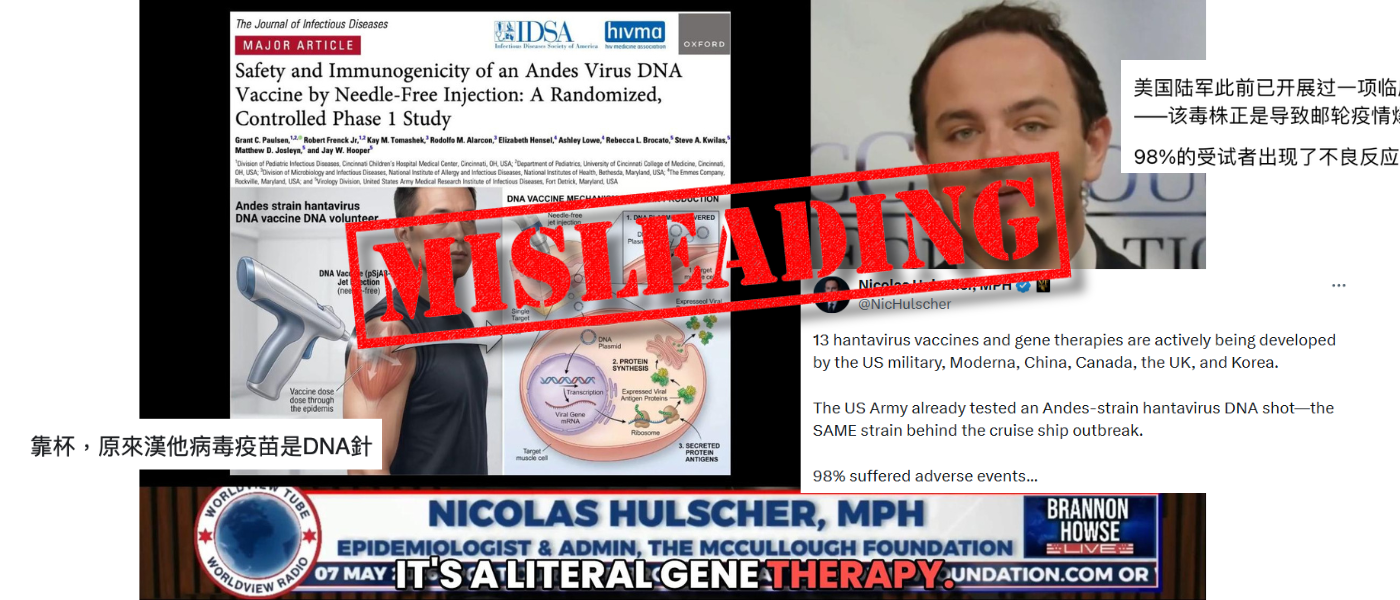
In early May, shortly after reports of a hantavirus cluster on the cruise ship MV Hondius emerged, Nicolas Hulscher, a known vaccine skeptic with more than 247,700 followers on X, claimed in a video that U.S. Army and pharmaceutical companies have already developed or are developing 13 hantavirus vaccines or gene‑based treatments.
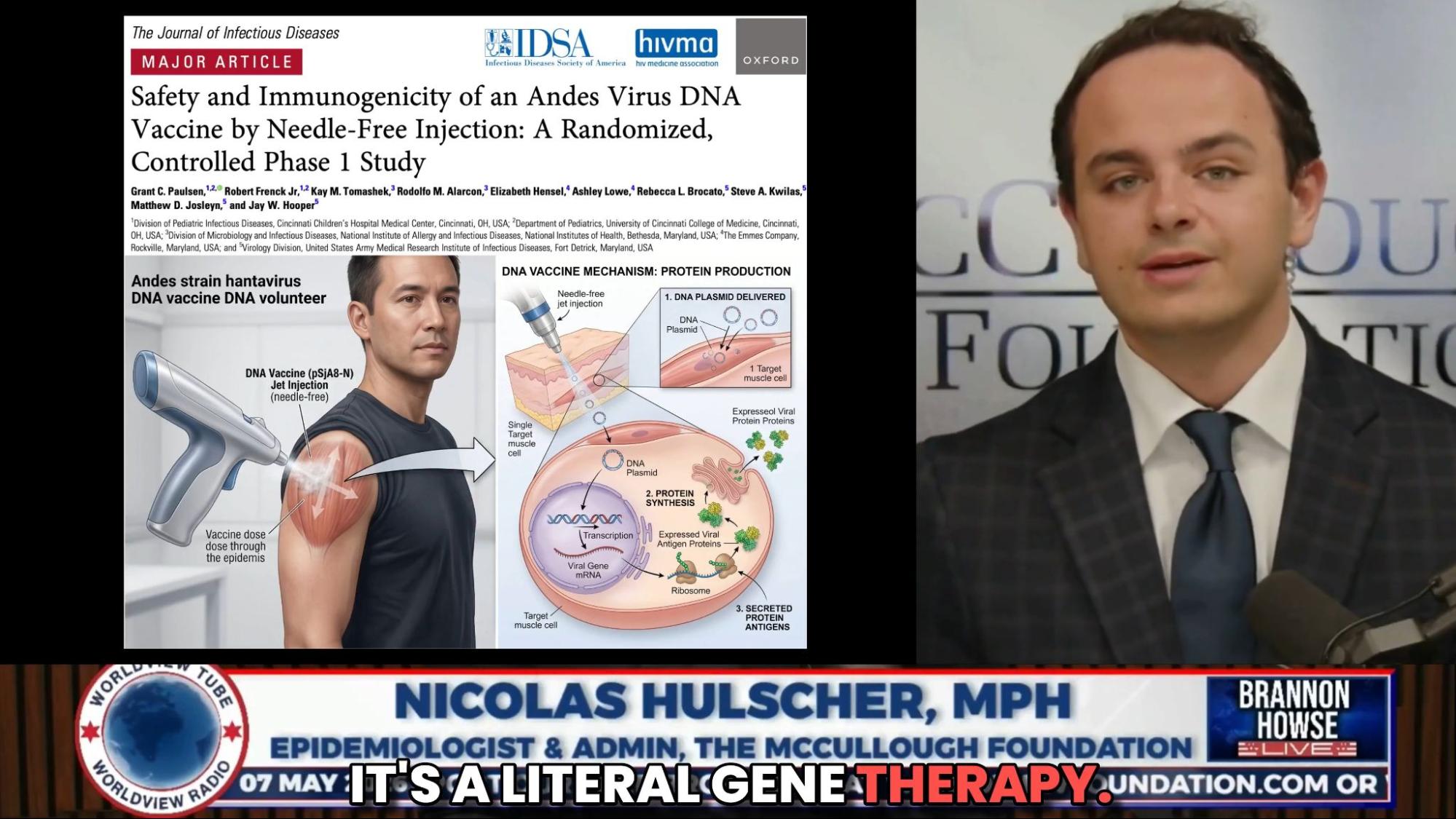
He called the U.S. Army version of the alleged vaccine a “DNA injection,” describing it as a “gene therapy” delivered through a needle‑free device, saying that it was associated with a high rate (98%) of adverse events in a clinical trial.
He also went on to claim that this particular product targets the Andes strain of hantavirus, the same strain involved in a recent cruise ship outbreak, adding that mRNA vaccines are also being developed by organizations such as Moderna and international partners. He suggested that the timing of these developments implies prior knowledge of a forthcoming outbreak or event.
In a video posted on X the following day, Hulscher further asserted that the hantavirus situation is being used to create fear and pressure countries, especially the United States, to support the pandemic treaty and rejoin the World Health Organization. He argued the outbreak is unlikely to spread widely, implying that the case is being exaggerated for influence while mentioning major WHO donors such as Bill Gates.
The X post has garnered 4,500 likes, 2,800 shares and hundreds of comments; Hulscher also published the same narrative on his website, in which he described pharmaceutical companies, academic researchers, and government agencies as a “vaccine cartel” and said the U.S. Army’s “DNA vaccines” are not true vaccines but plasmid‑based “gene therapies” that cause human cells to produce “pathogenic” hantavirus proteins.
Some users later shared these claims on Facebook and Threads in Chinese, along with some key visuals found in the video; one Facebook post linked to Hulscher’s website as a source.
However, all these claims are misleading. They falsely conflate DNA vaccines with gene therapy. They also include facts, such as the DNA delivery mechanism, a trial statistic, and research timing, but without the context needed to understand what they actually indicate.
How DNA vaccines work, and why they are different from gene therapy
DNA vaccines work by delivering genetic instructions, rather than the antigen itself, to prompt an immune response. They use a small, circular piece of engineered DNA called a plasmid that encodes a viral protein.
After injection, some cells take up this DNA, produce the antigen, the part of a virus that elicits an immune response, and present it to the immune system, which then generates antibodies and activates T‑cells, white blood cells that play a key role in fighting infection.
The DNA remains separate from a person’s chromosomes, is expressed temporarily, and is eventually broken down. It does not alter the recipient’s genetic makeup.
This makes DNA vaccines “totally different” from gene therapy, said Ivan Hung, chair professor of infectious diseases and vaccinology at the University of Hong Kong and the co-editor-in-chief of the journal Vaccine, in a written response to Annie Lab.
A DNA vaccine is a disease-preventive tool that uses genetic instructions to trigger an immune response, while gene therapy is a medical treatment designed to make lasting changes to a patient’s genes to treat or cure a disease.
“The plasmid DNA does not alter your genome as it remains in the cytoplasm, which lacks the integrase enzyme to be integrated [into] your chromosome,” Hung said.
Both the U.S. Food and Drug Administration and the WHO classify plasmid DNA products for infectious disease prevention as vaccines, not gene therapies. Gene therapy is a distinct regulatory category with a different purpose, mechanism, and framework.
DNA vaccines are relatively stable and easier to manufacture than some other platforms, though their effectiveness in humans depends in part on how efficiently the DNA is delivered into cells.
“DNA vaccines generally show moderate immunogenicity in humans and [are] not as immunogenic when compared to mRNA vaccines,” added Hung. “Nevertheless, it is more practical in terms of thermostability and rapid manufacturing.”
DNA vaccines in human use
According to a 2024 paper in an academic journal also titled Vaccines (Basel), the first DNA vaccine approved for human use was India’s ZyCoV-D COVID‑19 vaccine (archived here), following decades of research and earlier clinical trials that demonstrated the technology’s feasibility and safety despite not reaching the market.
ZyCov-D received emergency use authorization in India after a Phase 3 clinical trial (archived here) in 2021 involving more than 28,000 participants, which reported 66.6% efficacy after three doses.
Most reported side effects were mild or moderate and similar to those reported with other vaccines, such as injection-site pain, headache, fever, and fatigue, and no serious adverse events were found to be related to the vaccine. Its limited distribution began in February 2022 (archived here).
Although hundreds of DNA vaccine candidates have been tested or are in clinical trials for a wide range of diseases, including infectious diseases and cancers, DNA vaccines remain uncommon in human use.
While multiple COVID‑19 DNA vaccine candidates have reached clinical trials, including one developed (archived here) by the University of Hong Kong, none are widely deployed. The technology is more established in veterinary medicine, where several DNA vaccines have been approved and are in use.
Other claims related to vaccine development
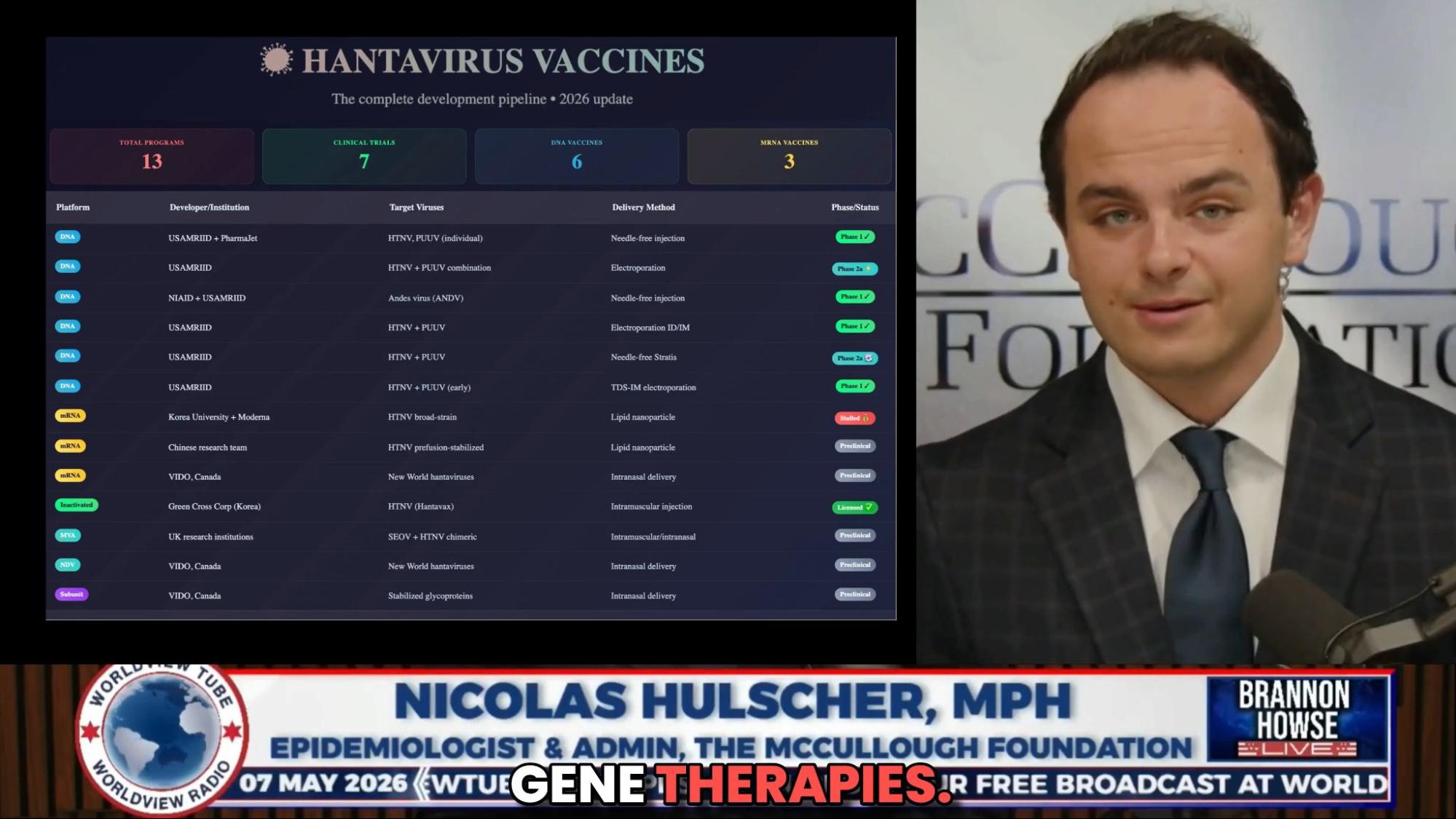
The X video features a table listing 13 purported hantavirus DNA vaccine candidates, for which no clear data source is provided.
The table featured in Hulscher’s X post and website listing 13 DNA vaccine candidates against hantavirus “in active development” lacks a clear source of data; many of the vaccine candidates are also difficult to identify due to insufficient descriptions in the table.
Annie Lab reached out to Hulscher for details on the listed DNA vaccine candidates but has not yet received a response.
Meanwhile, we tracked one particular study referenced in his video titled “Safety and Immunogenicity of an Andes Virus DNA Vaccine by Needle-Free Injection: A Randomized, Controlled Phase 1 Study” (archived here) published in 2023.
The Phase 1 clinical trial (trial registration: NCT03682107) was completed in 2020. Almost all participants (98%) reported at least one injection-site adverse event, including common symptoms after vaccination, such as redness (90%), pain (67%), or a lump at the injection site (90%).
The paper noted the majority of these expected symptoms were mild or moderate. Critically, all eight participants in the placebo group, who received needle-free injections without the vaccine, also experienced similar injection-site reactions, indicating that the reactions were caused by the jet-injection device itself, not the vaccine payload.
The list also labelled many vaccine candidates as developed by the U.S. Army Medical Research Institute of Infectious Diseases (USAMRIID). Indeed, four of the ten authors of the clinical trial report were researchers in the virology division of the institute that developed the Andes virus vaccine evaluated in the trial, as the paper acknowledged.
A search for DNA vaccines related to hantavirus led to earlier studies dating back to 2003 involving hamsters, published in the Journal of Virology. Jay Hooper, a co-author of both studies and a virologist at USAMRIID, recently told Nature in an interview that the institute had been working on hantavirus vaccines since the 1980s, and he joined the team in the 1990s.
Annie Lab could not find any documented information regarding the development of the vaccine candidate after the Phase 1 clinical trial and reached out to Hooper. We will update this story when we hear from the researcher.
What we know about hantavirus-related vaccine development
A 2019 review on the prevention and treatment of hantavirus disease, of which Hooper was also listed as a co-author, highlights that efforts to develop vaccines and therapeutics have been underway for decades, reflecting sustained scientific interest rather than responses to any single recent outbreak.
Hantaviruses are associated with two main clinical syndromes that differ by region and viral strain.
In Europe and Asia, they primarily cause hemorrhagic fever with renal syndrome (HFRS), which affects the kidneys and blood vessels. Historically, vaccine development has focused first on HFRS‑causing hantaviruses.
The Hantaan virus, a member of the hantavirus family that causes HFRS, was identified in the 1970s. Since then, inactivated vaccines have been developed and approved for use in South Korea in 1990 and China in 2005 (archived here), according to the Canadian government’s website. But the efficacy of the vaccine developed in South Korea has been questioned by the U.S. Centers for Disease Control and Prevention.
In the Americas, different members of the hantavirus family cause hantavirus pulmonary syndrome (HPS), a severe respiratory disease affecting the lungs and heart. Within this group, the Andes virus found in South America is distinctive as it is the only known hantavirus with confirmed human‑to‑human transmission, according to the same 2019 article published in the journal Viruses.
ABC News in the U.S. reported that research on viruses that cause HPS, including the Andes virus, has emerged more recently and progressed more slowly, in part because infections are relatively rare and outbreaks tend to be limited in scale.
More recent work since the 2000s has explored newer platforms such as DNA vaccines and other genetic approaches. Some experimental candidates, including those targeting the Andes virus, have reached early‑phase clinical trials, but they remain investigational.
Currently, no vaccines against hantaviruses have been recognized by the WHO.
These efforts reflect long‑standing, incremental research programs spanning multiple countries, institutions, and viral strains. There is no evidence that they were initiated in response to any single recent outbreak or developed with foreknowledge of specific events; rather, they are part of broader, ongoing efforts to prepare for a range of known hantaviruses.
Patterns of anti-vax narratives
Nicolas Hulscher holds a Master of Public Health (MPH) degree from the University of Michigan, according to his biography, and refers to himself as an epidemiologist. He has been publicly discussing vaccine safety, particularly issues related to COVID‑19 vaccines.
Several independent fact‑checking and media organizations investigated the vaccine-related claims attributed to Hulscher. For example, in January 2025, Science Feedback reviewed his statements suggesting COVID‑19 vaccines have “negative efficacy” and found these claims were unsupported and based on a misinterpretation of data.
In October 2025, Al Jazeera examined claims he promoted about a South Korean study allegedly linking COVID‑19 vaccines to cancer and concluded that the study did not support those claims; Hulscher later described that fact-check as “defamatory” in a response published on his own platform. BBC and Full Fact also independently looked into the same study and found the claim to be misleading.
In May 2026, AFP Fact Check similarly assessed claims he circulated about vaccine risks and found them inconsistent with available evidence.
Hulscher’s work is connected to the McCullough Foundation, an organization founded by cardiologist Peter McCullough, which is often associated with vaccine misinformation. Its claims on vaccines (such as linking vaccination to autism) were found to be relying on selective or misinterpreted evidence, appearing in journals whose scientific standards have been questioned, or repeating arguments that have been widely challenged by the broader scientific community.
Academics and the media have also scrutinized McCullough’s work. For instance, a 2024 paper co‑authored by McCullough was retracted by the journal Cureus, which stated its conclusions were “unreliable” due to concerns about the validity and misrepresentation of cited evidence.
Note: Perplexity’s Deep Research tool was used during the initial phase of this investigation to identify academic references, relevant media coverage, and experts in the field. Annie Lab reporters and editors independently verified all information and original sources before finalizing this story.

