Analysis: Overlapping EU regulations fueled confusion over smartphone batteries
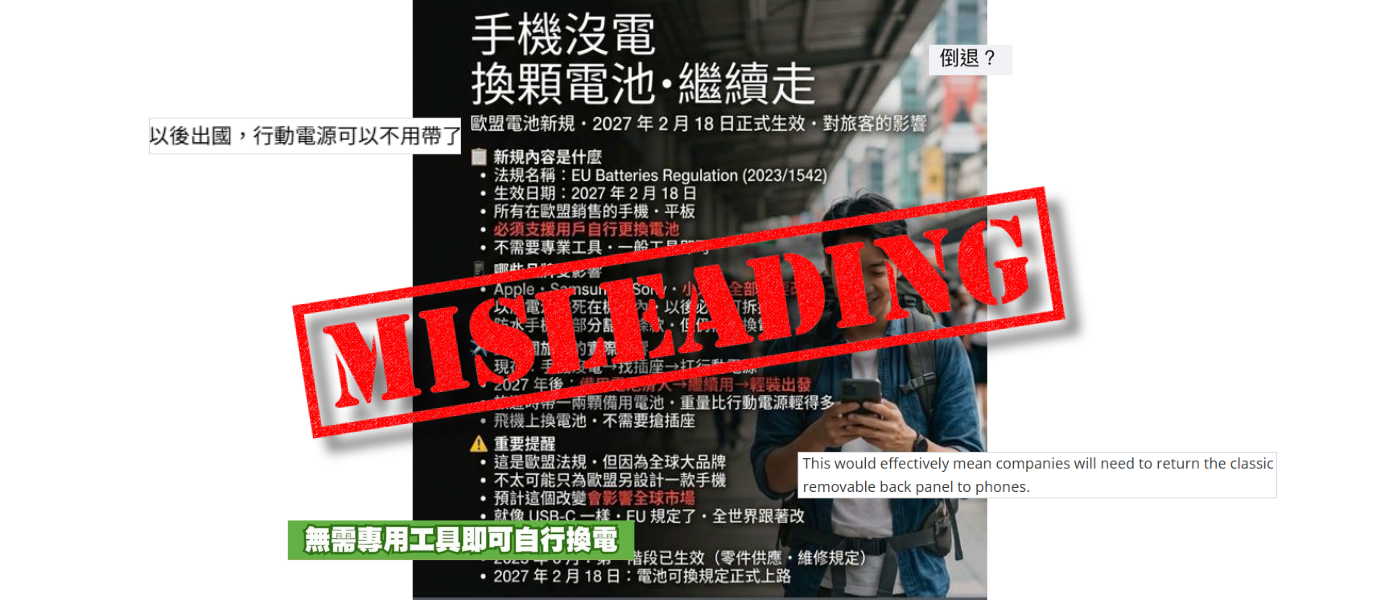
In late April, a viral post on Threads claimed in Chinese that, due to a new European Union regulation taking effect on Feb. 18, 2027, all smartphones, including those from Apple, Samsung, Sony, and Xiaomi, will be required to support user-replaceable batteries without the need for professional tools.
The post stated that travelers would no longer need to carry power banks, as they could simply swap in a spare battery on the go, and predicted that manufacturers would adopt this design globally.
The now-deleted Threads post was originally shared by a Taiwanese online eSIM store, receiving 6,500 likes and 7,100 shares; the infographic poster from this post was later reuploaded on the Hong Kong online forum LIHKG and a Facebook group.
Similar discussions in Chinese and also in English about “removable batteries by 2027” can be found on the Hong Kong online media UTravel, Reddit, a compliance consulting firm’s website, and in a book chapter on lithium-ion batteries that referenced a digital publication’s coverage for the upcoming return of the “classic removable back panel.”
However, while the named regulation exists, a separate EU regulation that takes precedence over it in governing the replaceability of smartphone batteries was often not mentioned in those discussions.
While the governing document referenced by the Threads post and others is Regulation (EU) 2023/1542, commonly known as the EU Batteries Regulation published in the Official Journal of the European Union on July 28, 2023, there is another instrument that simultaneously governs batteries specifically in smartphones and tablets on the EU market, Regulation (EU) 2023/1670, commonly known as the EU Ecodesign Regulation.
The Ecodesign requirements became binding on manufacturers in June 2025, and they take precedence over the Batteries Regulation, as stated in section 2.2 of the Commission guidelines. The Ecodesign rule does not require all smartphone batteries to be easily accessible to end-users, contrary to what the viral posts claim.
Many users seem to have been confused because the Batteries Regulation states that portable batteries incorporated into products must be “readily removable and replaceable by the end-user at any time during the lifetime of the product,” applicable from Feb. 18, 2027.
This broader regulation covers five categories of batteries: portable batteries (such as AA, 9V cells, or those in mobile phones), batteries for light means of transport, electric vehicle batteries, starting/lighting/ignition (SLI) batteries, and industrial batteries. But ultimately, the replaceability of batteries in smartphones and tablet devices is governed by the Ecodesign Regulation.
What Ecodesign Regulation says
The Ecodesign Regulation sets requirements for the design of mobile phones sold in the EU market, as well as for access to repair and maintenance information, primarily to facilitate easier repair and parts replacement, thereby supporting longer product lifespans and boosting energy efficiency.
Smartphone manufacturers are obligated to ensure key spare parts, including batteries and screens, are available to both end-users and professional repairers for at least seven years after the product model is no longer sold in the EU.
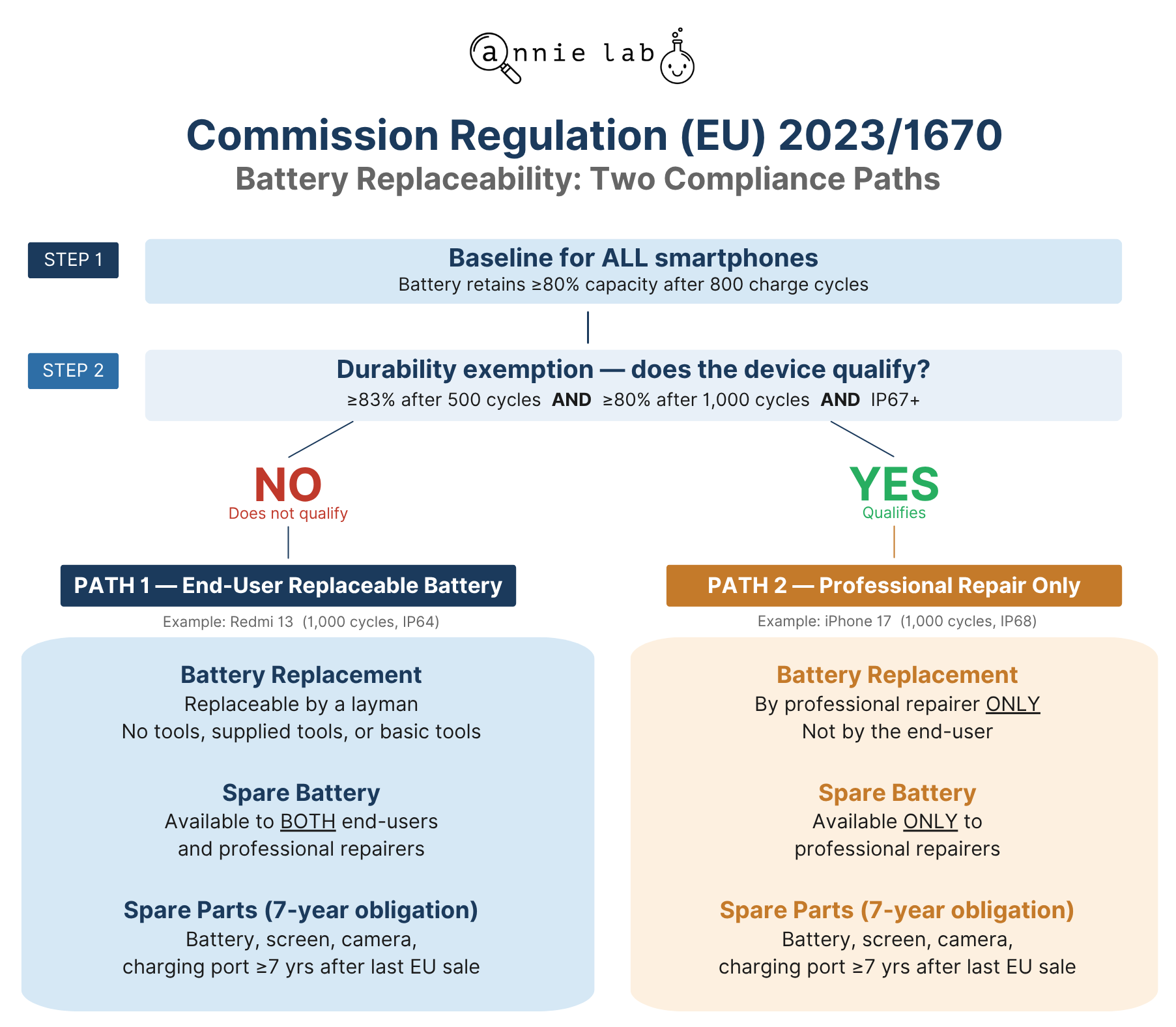
The regulation creates two compliance paths for manufacturers regarding battery replaceability. They must either 1) fit batteries that are easily replaceable by a layman end-user, or 2) produce sufficiently durable batteries that need only be replaced in a professional repair workshop.
Under the first path, replacing the battery must be feasible without tools, with tools provided with the product, or with basic tools, such as screwdrivers and tweezers, in a layperson’s use environment. Fasteners used in the phone cannot leave residue or cause damage when removed. [Annex II, Section B, 1.1(5)(c)(i)]
Under the second path, if manufacturers use more durable batteries, spare batteries are required to be provided to and replaceable by a professional repairer only, not by the end-user.
To qualify for this exemption, a smartphone must satisfy two battery endurance criteria: 1) the battery must retain at least 83% of its rated capacity after 500 full charge cycles, and at least 80% after 1,000 full charge cycles, and 2) the device must carry a minimum IP67 water and dust resistance rating (completely dust-tight and protected against temporary immersion in water). [Annex II, Section B, 1.1(1)(c)(ii) & (5)(c)(ii)]
Third-party compliance advisory guide by the EU Compliance Services for consumers and suppliers also summarized on the battery replacebility requirements in the regulation (archived here and here).
Major models unlikely to be serviceable by users
A review of the European Product Registry for Energy Labelling database (EPREL), which provides energy efficiency information on products sold in the EU, shows that most flagship smartphones from major brands like Apple and Samsung currently available likely satisfy the battery durability requirement and can be exempt from the requirement to make the battery replaceable by end-users.
Annie Lab requested confirmation from the European Commission’s Spokesperson’s Service on the battery replaceability exemption conditions and the implementation date of the Ecodesign Regulation.
We inquired about certain smartphone models available in the EU market after the regulation’s implementation last year; these models have non-removable batteries but their technical specifications do not appear to meet the conditions, according to the EPREL.
The Commission’s Directorate General for Internal Market, Industry, Entrepreneurship and SMEs, commonly known as DG GROW, is the primary department in charge of implementing the specific Ecodesign regulations.
The service declined to reply and referred us to the Europe Direct contact center.
In its written response, Europe Direct said it cannot interpret EU law or assess compliance of specific models, and referred us to general EU guidance.

