Misleading: Egypt’s football team did not curse ‘infidels’ in viral locker-room video
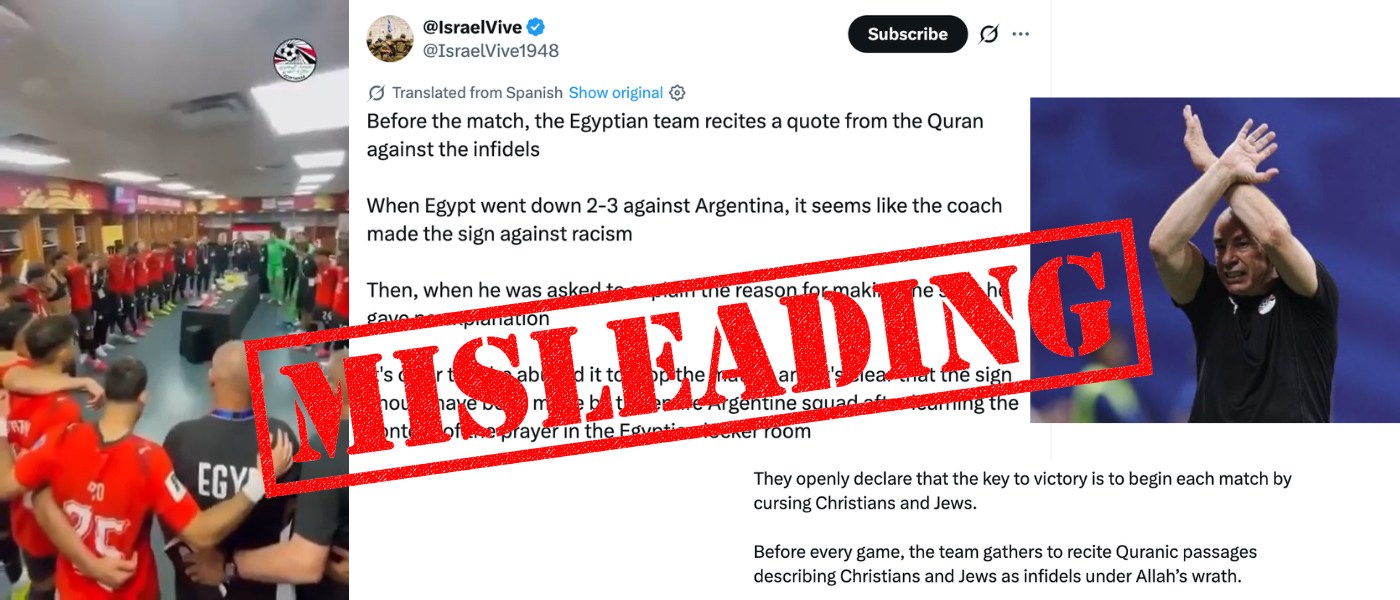
On July 8, a post on X claimed that the Egypt’s national football team recited Quranic passages against “infidels” (a derogatory term historically used by both Christians and Muslims for someone who does not share their religion) in the dressing room shortly before the FIFA World Cup match against Argentina on July 7.
The post, written in Spanish, further alleged that after Egypt fell 2-3 to Argentina, head coach Hossam Hassan used FIFA’s anti‑racism “X” gesture to try to stop the match, portraying this as contradicting the team’s religious prayers before games.
The post gained over 34,000 likes, 4,600 reposts, and 510 comments. Similar claims appeared in other posts on X and Facebook.
In Annie Lab’s review, the earliest version of the similar claim traces back to a June 22 post on X by Safaa Sobhi, a journalist affiliated with the Ideological Defense Institute, a think tank that advocates for Western and Judeo-Christian values.
Our investigation found that on June 22, the day of the New Zealand–Egypt group-stage match, Egypt’s national team actually uploaded the video in question on its Facebook page (archived here).
We learned that the Quranic passages recited in the video are prayers seeking Allah’s blessings and commonly used across Arabic-speaking regions.
Quranic prayers for Allah’s blessings
To verify the verses recited in the viral video taken before the New Zealand match, Annie Lab consulted two native Egyptian Arabic speakers, as well as Sarah Abdallah, a journalist and media development expert from Lebanon and founder of an online community for Arab journalists.
The team began with the phrase “I seek refuge in Allah from Satan, the accursed,” a common invocation used before reciting the Quran.
According to one native speaker, it is a short Islamic prayer said to seek Allah’s protection from “the devil’s influence,” such as harmful or negative thoughts.
It is typically recited before reading the Quran, starting a task, or in moments of discomfort or worry, and is not directed at any external individual or group.
The team then recited “The Opening,” or Al-Fatiha, the first chapter of the Quran, a standard prayer read in everyday situations such as weddings and funerals.
They followed with “The Sincerity,” also known as Al-Ikhlas, one of the shortest chapters in the Quran, recited three times. The prayer ended with an Arabic phrase that translates to “Allah, make the difficult easy.”
| Starting phrase | Chapter 1: Al-Fatiha (The Opening) | Chapter 112: Al-Ikhlas (The Sincerity) | End recitation |
| I seek refuge in Allah from Satan, the accursed. [Source] | In the name of Allah—the Most Compassionate, Most Merciful. All praise is for Allah—Lord of all worlds, the Most Compassionate, Most Merciful. Master of the Day of Judgment. You alone we worship, and You alone we ask for help. Guide us along the Straight Path, the Path of those You have blessed—not those You are displeased with, or those who are astray. [Source] |
In the name of Allah—the Most Compassionate, the Most Merciful. Say, O Prophet, “He is Allah—One and Indivisible; Allah—the Sustainer needed by all. He has never had offspring, nor was He born. And there is none comparable to Him.” [Source] |
O Allah, there is no ease except in what You make easy. If you wish, you can make the difficult easy. [Source] |
Prayers before other matches
It is a common practice for Egypt’s team to pray and recite the Quran before matches.
Annie Lab found six additional videos of the same routine before matches against other nations, including those from Muslim countries, on the team’s Facebook page.
We confirmed that the team mostly recited the same Quran chapters and phrases, with slight variations in the chanting at the beginning and end of the prayer.
For instance, in a video from March 31 (archived here), before the match against Algeria, the team ended the prayer with, “In the name of Allah, we rely on Him; there is no power nor strength except by Allah.”
This phrase does not come from the Quran but is a common expression meaning “May Allah be on our side,” according to the native speakers we talked to.
In another video, uploaded on June 16 (archived here) before the Belgium-Egypt match, a coach was heard gathering the team for a prayer beginning with “The Opening” and expressing hope for divine guidance and a win that would make their country happy.
None of the three Arabic speakers consulted by Annie Lab said Egypt’s team “cursed” infidels or any individuals of other ethnic or religious backgrounds in any of the videos.
The six videos of pre-match prayers uploaded by Egypt’s team are listed below:
- Saudi Arabia vs. Egypt (March 27)
- Egypt vs. Algeria (March 31)
- Belgium vs. Egypt (June 16)
- Egypt vs. Iran (June 27)
- Australia vs. Egypt (July 4)
- Argentina vs. Egypt (July 8)
Anti-racism gesture
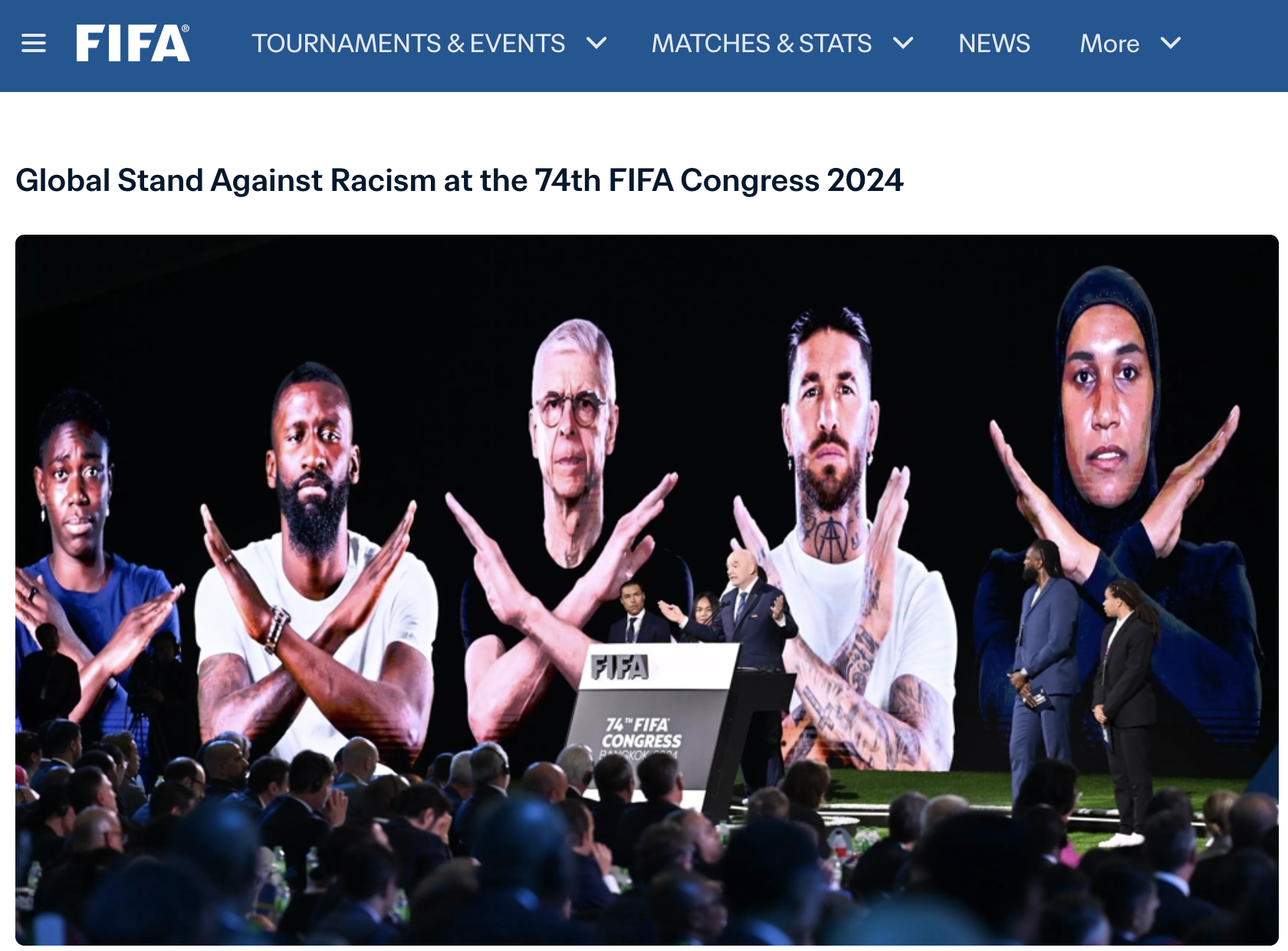
During the match against Argentina on July 7, Egypt’s head coach Hassan held his arms in a cross over his head, a signal for reporting racist incidents.
According to FIFA (archived here), referees can pause a match and issue warnings when the gesture is made; if the situation persists, they can suspend or abandon the match.
Hassan’s gesture came in reaction to a red card issued to an Egyptian coaching staff member in the 94th minute of the match, the Mirror reported. French referee Francois Letexier reportedly ignored Hassan and issued him a yellow card.
FIFA introduced the gesture at the FIFA Under-20 Women’s World Cup in Colombia in 2024, following its approval at the 74th FIFA Congress in Bangkok.
For the 2026 World Cup, FIFA introduced a new rule allowing players who cover their mouths during on-field confrontations to be sent off, preventing abusive language from being hidden from cameras and lip-readers, according to DW.
At the post-match press conference, Hassan called the match “unfair,” but Annie Lab found no public comment from the head coach discussing his X gesture.
Broader controversy over Egypt’s defeat to Argentina fuels misinformation
Hassan and several Egypt players publicly expressed frustration after the match, claiming that officiating decisions were inconsistent and unfair.
The Egyptian Football Association subsequently requested an investigation into Letexier and the officiating team.
The controversy also fueled allegations that FIFA officials favored Argentina.
Other fact-checkers, including India’s NewsMeter and The Sunday Guardian, have debunked claims that FIFA President Gianni Infantino openly supported Argentina and that Lionel Messi confronted Egypt’s coaching staff after the match, finding that the viral videos had been misrepresented or lacked supporting evidence.
FIFA, meanwhile, rejected accusations of bias, according to a report by Reuters.
Similarly, on June 24, Al-Jazeera’s Arabic service fact-checked claims portraying Egypt’s national team as praying against Christians and Jews.
The news outlet found that they were based on a misrepresentation of a video showing players reciting common Quranic prayers before a match and concluded some social media accounts misleadingly amplified the footage as “religious incitement.”


