Analysis: Viral post misleadingly links sunscreen use to higher cancer risk
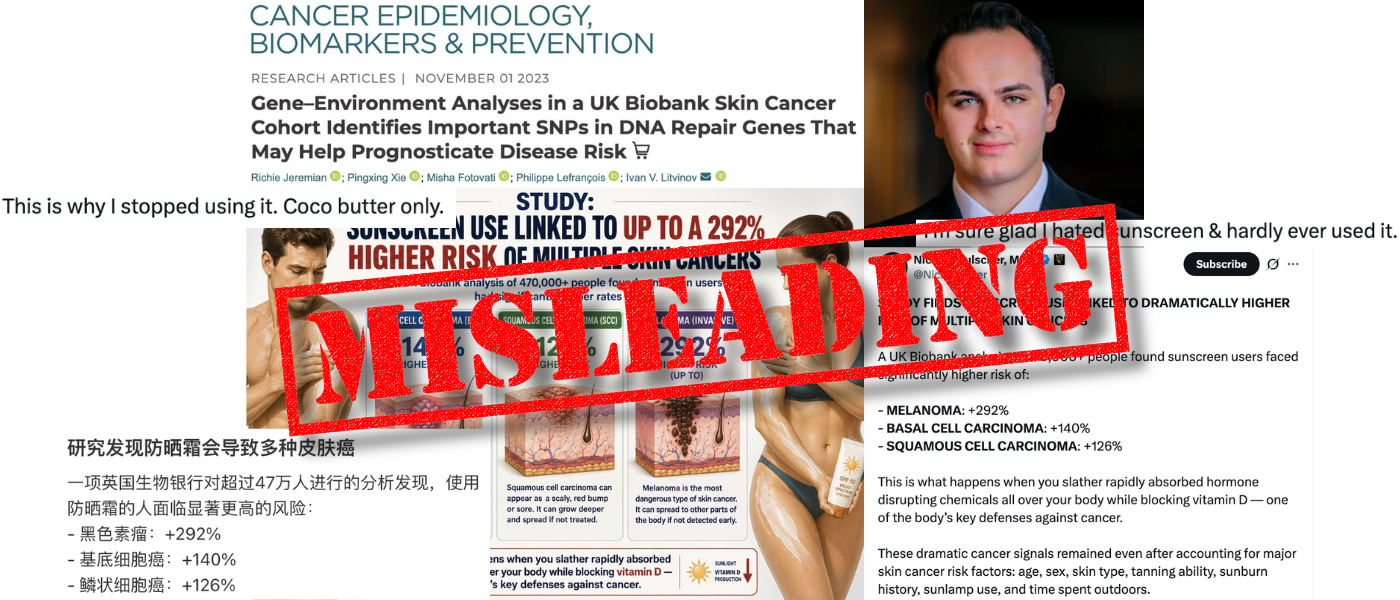
In a post published on X on June 10, Nicolas Hulscher, an anti-vaccine commentator with more than 257,900 followers on the platform, claimed that a study using U.K. Biobank data found “sunscreen use linked to dramatically higher risk of multiple skin cancers,” citing specific figures for three types of skin cancer that allegedly range from “+126%” to “+292%.”
He further claimed that the increased skin cancer risk remained “after accounting for major risk factors including age, sex, skin type, tanning ability, sunburn history, sunlamp use, and time spent outdoors.”
Hulscher also asserted that sunscreen contains “rapidly absorbed hormone-disrupting chemicals all over your body” that block vitamin D, which he described as a “key defense against cancer.”
Within two days, his post gained over 9,800 likes, 4,800 reposts, and 272 replies. Similar claims were made and shared by other users on X, and the post has been translated into Chinese on Weibo and Xiaohongshu.
However, his remarks misrepresent the findings of the research paper he cited, which was published in the journal Cancer Epidemiology, Biomarkers & Prevention in November 2023. His other assertions about vitamin D and chemicals in sunscreens are also largely unsubstantiated in scientific literature.
Study taken out of context
The study referenced by Hulscher, visible in a screenshot in his X post, is titled “Gene-environment analyses in a UK Biobank skin cancer cohort identifies important SNPs in DNA repair genes that may help prognosticate disease risk.”
Researchers from McGill University analyzed U.K. Biobank data to investigate how genetic and environmental factors affect skin cancer risks.
The study reported that frequent sunscreen use was statistically associated with moderately to strongly increased risk of four types of skin cancer in the cohort. But the authors explicitly attributed this link to possible behavioral factors, such as greater UV exposure after applying sunscreen, inadequate reapplication, or sunscreen use only after a skin cancer diagnosis, rather than any harmful effect of sunscreen itself.
They also wrote that the findings underscore the importance of “adequate and frequent sunscreen use” and minimizing UV exposure, especially for people with fair skin.
In the analysis, sunscreen use appears as one of several sun-related behaviors considered alongside skin and hair color, sunburn history, sunlamp use, and sun exposure, and it is not the central focus of the paper.
A U.S. fact-checking outlet, Snopes, also looked into a similar claim citing the same paper by another user circulating online and labeled it as false.
The sunscreen paradox
In a written email response to Annie Lab, Ivan Litvinov, an associate professor of dermatology at St. Mary’s Hospital Centre and McGill University in Canada and one of the study’s authors, said the X post has misinterpreted their research.
“The proper use of sunscreen, combined with other sun-protection measures, reduces the risk of skin cancer,” he said, adding that the benefit has been shown in studies and reflected in public health outcomes in Australia.
Litvinov explained that problems arise when people treat sunscreen as a “permission to tan.” This “sunscreen paradox” occurs when use of sunscreen encourages prolonged sun exposure without other protective measures.
Even when people apply insufficient amounts or fail to reapply as recommended, they gain a “false sense of security” and spend more time in the sun, according to Litvinov, ultimately exposing themselves to more cumulative UV damage, increasing their risk of developing skin cancer.
Other researchers have reached similar conclusions. For example, a 2019 systematic review titled “Challenges in assessing the sunscreen-melanoma association” notes that some observational studies have reported higher melanoma rates in sunscreen users, but said those findings largely reflect study limitations and high-risk behavior in sunscreen users, not a harmful effect of sunscreen itself, and require cautious interpretation.
Earlier research often failed to adequately account for the fact that people at highest risk, such as those with fair skin, prone to sunburn, or frequent sun exposure outdoors, are more likely to use sunscreen but may apply it too sparingly or stay in the sun longer.
When other factors of risk, such as skin types and sun exposures, are properly accounted for, the protective effect of sunscreen becomes clearer. The only randomized controlled trial included in the review, in which participants were randomly assigned to daily sunscreen use or discretionary use, found that sunscreen has a protective effect against melanoma.
Claims about chemical absorption
Hulscher’s post also raised alarm about sunscreen ingredients being absorbed into the bloodstream.
A randomized clinical trial by U.S. Food and Drug Administration researchers did find that some chemical UV filters can be detected in blood above 0.5 nanograms per milliliter when sunscreen was applied at least every two hours over several days to large skin areas.
However, the threshold is a trigger for additional toxicology testing, and that detection in blood does not mean a substance is harmful.
The paper’s authors also stated that their findings “do not indicate that individuals should refrain from the use of sunscreen.” The FDA (archived here) and dermatology experts continue to recommend sunscreen use as part of a broader sun protection strategy.
Some chemical UV filters, such as oxybenzone, have raised concerns about possible endocrine-disrupting effects. Systematic reviews (here and here) of human observational studies and laboratory tests have reported associations between exposure to certain sunscreen active ingredients and alterations in hormone levels.
But many animal and in vitro studies (laboratory tests) showing concerning results used doses far higher than those seen with routine topical use and often delivered the chemicals orally rather than via the skin, as noted in an article by Harvard Health Publishing. Researchers have pointed out that biological effects observed in those experiments generally occurred at exposure levels that do not reflect real-world sunscreen use.
Articles by Harvard Health Publishing and Stanford Medicine say there is no conclusive evidence that approved sunscreen ingredients are harmful to humans at typical exposure levels and recommend continued sunscreen use to reduce skin cancer risk.
The same systematic reviews note that observational studies of endocrine makers are subject to confounding factors, including seasonality and socioeconomic patterns, and that exposure to UV filters can also come from cosmetics and other products, not just sunscreens.
Sunscreen, vitamin D, and cancer
The X post also claims sunscreen use lowers vitamin D levels. While laboratory experiments show that sunscreens can block UVB radiation needed for vitamin D synthesis, studies in people have not found strong evidence that real-world sunscreen use causes clinically significant vitamin D deficiency.
A 2019 review in the British Journal of Dermatology reported that sunscreen appears to interfere less with vitamin D production in outdoor settings than laboratory experiments suggest, partly because of differences in UVB wavelength distribution.
Another systematic review in the same journal found little evidence that sunscreen use substantially lowers vitamin D levels in everyday use. Two clinical trials (here and here), in which some participants were randomly assigned to daily sunscreen use found no differences in vitamin D levels between those groups and control groups.
Researchers have concluded that concerns about vitamin D should not deter people from using sunscreen. Because a limited number of foods naturally contain vitamin D, health agencies such as Britain’s National Health Service and the Mayo Clinic say supplements may be useful for people at risk of deficiency, especially in winter.
Hulscher’s argument against sunscreen hinges on the claim that reduced vitamin D production leads to higher cancer risk. But evidence linking vitamin D to cancer prevention remains mixed and, for most cancers, inconclusive.
According to a fact sheet from the U.S. National Cancer Institute (archived here), randomized controlled trials, generally have not found that vitamin D supplementation lowers the risk of developing cancer overall. Trials looking at whether Vitamin D reduces the risk of dying from cancer have reported varied results (here and here).
While vitamin D remains important for bone and general health, current evidence does not support characterizing it as “one of the body’s key defenses against cancer.” Its possible role in cancer prevention is still being investigated, and any potential benefits so far appear limited to specific cancers rather than cancer in general.
Recurring false claims about sunscreen
Claims that sunscreen is harmful have been repeatedly reviewed by other fact-checking organizations.
In April 2022, AFP Fact Check reported that experts and public health officials found no evidence of major harm from sunscreen use itself, noting that UV radiation is a direct cause of skin cancer. USA Today similarly reported in June 2022 that existing evidence supports sunscreen as generally safe and effective for reducing cancer risk.
In January 2024, AAP Fact Check reviewed a claim that skin cancer did not exist before sunscreen was invented and reported that medical literature documented skin cancer long before modern sunscreens became available.
Some claims use skin cancer statistics to argue sunscreen is dangerous. In July 2025, DW fact-checked a widely shared chart allegedly showing that countries with higher sunscreen use have higher skin cancer rates and found that the graphic did not come from the Connecticut Tumor Registry, contrary to the claim.
Another recurring narrative suggests sunburn is not harmful and that people can build a protective “solar callus” by gradual tanning.
A dermatology expert told USA Today in March 2023 that sunburn reflects an immune response to UV-damaged skin cells, but not all mutated cells are eliminated, noting that sunburn is not a safe or healthy way to develop resistance to UV radiation. AFP fact-checked a related claim in April 2025 and found that the cited study did not support that conclusion.
Other claims promote alternatives to sunscreen, such as antioxidant-rich foods or supplements like astaxanthin. AFP’s fact-check in June 2024 quoted experts who said there is no evidence that ingestible products can replace topical sunscreen in preventing sun damage. DW likewise reported in July 2023 that nutritional interventions cannot substitute for sunscreen and other physical sun-protection measures.
Some online posts recommended homemade or “natural” sunscreen. In a July 2024 fact-check article, AFP included expert warnings that homemade products may not provide reliable SPF, water resistance or stability, and may leave users inadequately protected from UV radiation.


