Analysis: Video falsely links metal experiment to vaccine ingredients
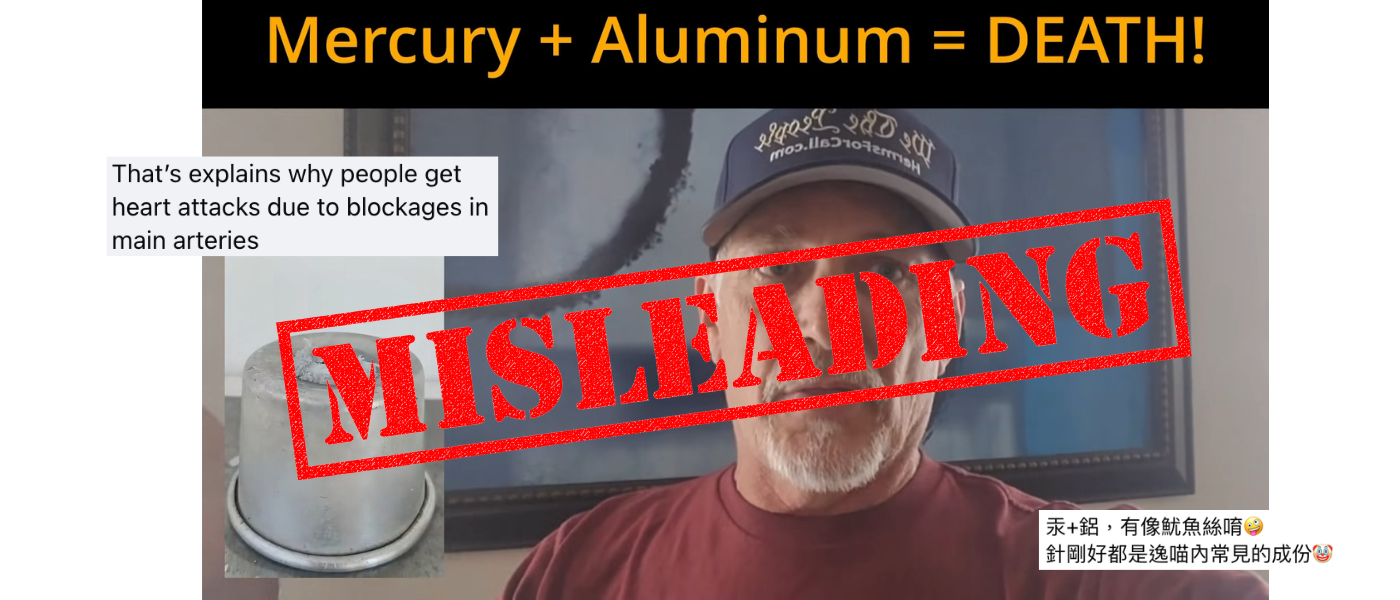
In late July, Lewis Herms, a California gubernatorial candidate who ran with no party preference in the state’s June 2026 primary, claimed in a video that a reaction between liquid mercury and metallic aluminum can occur inside people after vaccination.
In the video titled “Mercury + Aluminum = Death?”, Herms presents a clip in a small picture-in-picture window showing mercury reacting with aluminum. Fibrous, metallic-looking structures rapidly sprout from an aluminum container.
Herms, who has around 46,500 followers on Facebook, Instagram, and YouTube, suggests that a similar toxic interaction occurs in the human body when people are exposed to mercury and aluminum through vaccines or dental amalgam fillings.
He also claims the substances interact in the bloodstream to cause blood clots, from which pharmaceutical companies profit by treating the resulting conditions.
Herms also refers to “chemtrails”, a widely debunked conspiracy theory that contrails (visible clouds of vapor left by aircraft) contain toxic chemicals designed for purposes such as mass sterilization or weather control.
The video posted on his Facebook and Instagram accounts has garnered around 15,900 likes, 10,000 shares, and 900 comments in total. It has also been reposted by other users on X and on a Chinese-language anti-vaccine Facebook page.
However, his claims are misleading. The post conflates elemental metals with chemically different compounds that contain the same elements. He treats the reaction between elemental aluminum and liquid elemental mercury shown in the picture-in-picture clip as if it could occur with vaccine ingredients.
In fact, the demonstration footage, originally made for educational purposes, involves materials not found in vaccines.
Some vaccines contain aluminum salts, which are a chemical compound with completely new properties and do not act like raw metal.
Certain multidose vaccine vials have historically used thimerosal, a preservative that contains ethylmercury, which is also a chemical compound that behaves completely differently in the body than pure (elemental) mercury.
The educational video
Annie Lab traced the demonstration clip in the viral post to a YouTube Short posted in November 2024 by @RoyTheChemist, a channel whose description identifies its producer as a student studying undergraduate chemistry.
In the original video, the creator explains that hydrochloric acid removes aluminum’s protective oxide layer. This allows mercury to penetrate the exposed aluminum and form an amalgam, an alloy of mercury with another metal.
The aluminum then reacts with oxygen and moisture in the air, producing fibrous aluminum oxide over about 10 hours.
The clip has since been reposted across social media platforms, often without its original narration (examples here and here).

Different forms, different behavior
The reaction in the video involves elemental aluminum (Al0), or aluminum metal, and elemental liquid mercury (Hg0), a liquid metal.
Eden Booth and Celia Paramio, doctoral researchers in the Department of Chemistry at the Royal College of Surgeons in Ireland, told Annie Lab by email that neither is used in vaccines.
An element can exist in chemically distinct forms with different bonding, oxidation states, solubility, and reactivity. Those differences determine how a substance behaves.
For aluminum, these forms include elemental metal, aluminum oxide (also called alumina), and aluminum salts.
Elemental aluminum is a reactive metal. But aluminum salts are compounds used for purposes including water treatment, baking, and in some vaccines.
Some routine vaccines contain small amounts of aluminum salts to enhance the body’s immune response, including certain hepatitis A, hepatitis B, diphtheria-tetanus-containing, HPV, and pneumococcal vaccines.
They are not used in live attenuated vaccines such as MMR and rotavirus vaccines, according to the Children’s Hospital of Philadelphia.
“The key point is oxidation state and coordination chemistry, not just ‘aluminum,’ determine [the] behavior,” Booth and Paramio said.
They compared the distinction to sodium. “Metallic Na0 [sodium] reacts explosively with water, NaOH (lye) [sodium hydroxide] is caustic, and NaCl [sodium chloride] (table salt) is safe to eat,” they said.
“Same element, three completely different behaviors, depending on oxidation state and counter-ion.”
Use of ethylmercury in vaccines
Mercury also exists in elemental, inorganic, and organic forms, which are processed differently by the body.
Methylmercury (CH3Hg+) and ethylmercury (C2H5Hg+) are both organomercury compounds. Neither is elemental mercury, or mercury metal.
Thimerosal, which contains ethylmercury, is sometimes used as a preservative in multidose vaccines and other medical products to prevent bacterial and fungal contamination.
Ethylmercury is processed and eliminated from the body quickly. It is different from methylmercury, which can accumulate in fish and is associated with toxicity concerns.
The difference between the two compounds is chemically significant, Booth and Paramio said.
A parallel exists in alcohols: ethanol (CH3CH2OH) can be found in alcoholic drinks such as beer and wine. Methanol (CH3OH), on the other hand, is highly toxic even in small doses.
They differ by one carbon atom (ethanol has an additional CH2 unit), but that small difference gives them very different effects on the body.
In the United States, thimerosal has been removed or reduced to trace amounts in all vaccines routinely recommended for children age six or younger since 2001, except for some influenza vaccines.
Blood clots and other claims
The viral post also provides no evidence linking the laboratory amalgamation demonstration to blood clot formation. Amalgamation is a process of metal surface and alloy formation that does not occur in a human body.
Booth and Paramio said the post uses a “visual spectacle” to imply a causal relationship with an unrelated biological process.
The post also asserts that vaccines contain graphene oxide. Although researchers have explored graphene oxide’s possible use as a nanoparticulate-based adjuvant, it is not an ingredient in any authorized COVID-19 or influenza vaccines, according to Pfizer, the European Commission, and RMIT FactLab.
Recurring anti-vax narratives
Fact-checking organizations have repeatedly addressed claims about vaccine additives, including elemental mercury and aluminum, allegedly causing health harms and other conditions.
In January 2023, The Associated Press debunked viral videos making the same claim about the aluminum and mercury, explaining that the demonstrations use pure metals rather than aluminum salts and organic mercury compounds.
Snopes similarly examined the claim and related video in November 2023, emphasizing that vaccines contain tightly controlled trace compounds rather than raw elemental components.
In January 2024, USA Today reviewed another persistent claim linking aluminum adjuvants to autism, concluding that extensive research shows no evidence supporting such a connection.
The media organization also published a fact-check on the safety of mercury and aluminum in vaccines a month later, finding that these ingredients are regulated, well-tolerated, and present in quantities far too small to cause toxic harm.
Some of the related claims have also been examined by Chinese-language fact-checking organizations. In August 2021, the Taiwan FactCheck Center investigated claims about vaccine components and misconceptions about their alleged health risks.
In October 2022, MyGoPen published a fact-check addressing claims about thimerosal and aluminum hydroxide in seasonal vaccines.
