Misleading: Satellite image does not show crack in Three Gorges Dam
 【點擊查看本文中文版】
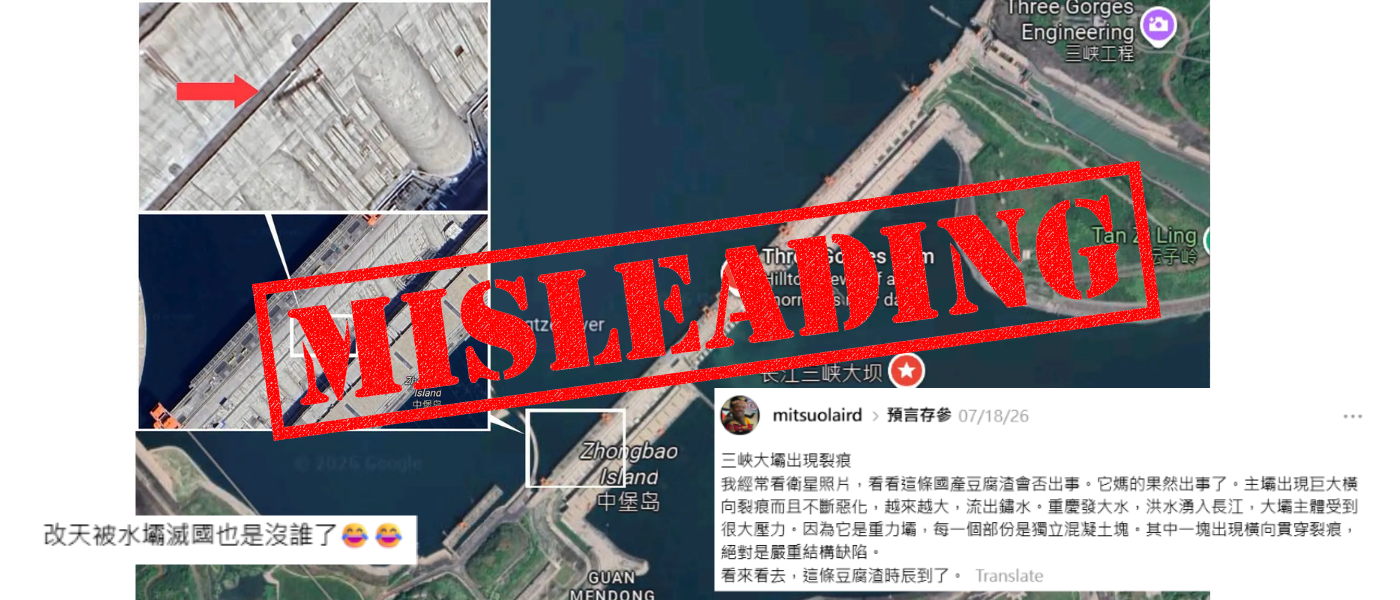
A Facebook post claimed on July 18, 2026, that satellite imagery of the Three Gorges Dam, a massive hydroelectric gravity dam on the Yangtze River in Hubei province, China, “revealed a huge transverse crack” that is widening over time and “leaking rusty water.”
The post said recent flooding in Chongqing had put immense pressure on the structure, creating a critical flaw in one of its concrete blocks. It suggested that the dam, described with the derogatory term “tofu-dreg project” (豆腐渣) for shoddy construction, would soon collapse.
The claim quickly spread to other platforms including Threads (here and here) and X. The Facebook post alone garnered over 4,100 likes, and thousands more engagements are seen on other platforms.
However, the claim is misleading.
The dark linear mark highlighted on the downstream face of the dam is not a structural defect or a seepage stain. Annie Lab reviewed a number of visual materials showing the dam and can confirm that it is a staircase photographed as early as 2008.
In an email to Annie Lab, Professor Lee Chack Fan, a geotechnical engineering expert who took part in the Dam’s construction, said the claim was “simply false,” noting that the satellite image is not accurate enough to support any interpretation and that the accusation reflected a lack of engineering knowledge.
Lee said staircases on a dam surface are used mainly for periodic inspection of the concrete as part of the safety monitoring program.
Satellite images show staircase
Visual comparison confirms that the satellite image used in the viral post was taken from Google Maps at 30°49’07.23″N 110°59’54.77″E.
The labels and the surrounding landmarks in the viral image match the latest satellite view available on Google Earth, which was taken in 2024.
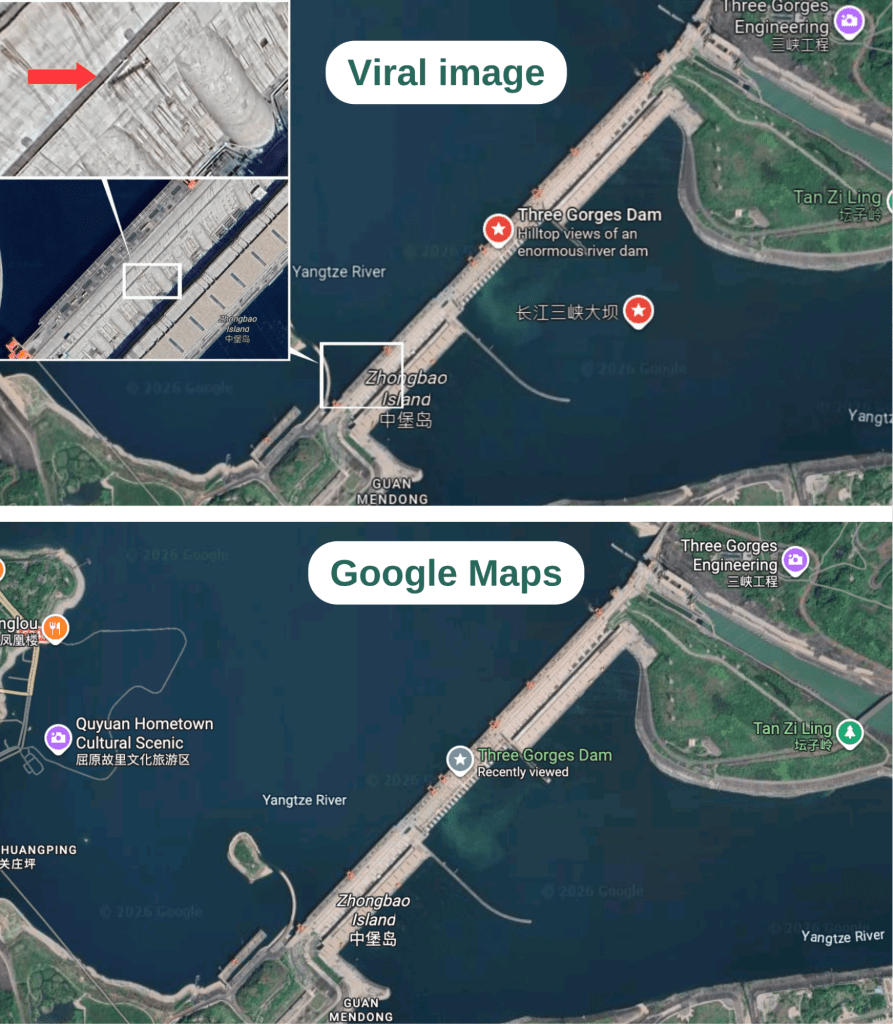
There are 14 generating units on the left bank and 12 on the right bank of the Three Gorges Dam.
To pinpoint the mark, Annie Lab cross-referenced the image with an academic paper, “The dam design of Three Gorges Project,” by three senior engineers, Wang Xiaomao, Xu Linxiang, and Liao Renqiang, who were involved in the project’s technical design.
Our comparison placed the mark between headrace pipes 23 and 24 on the right-bank powerhouse.

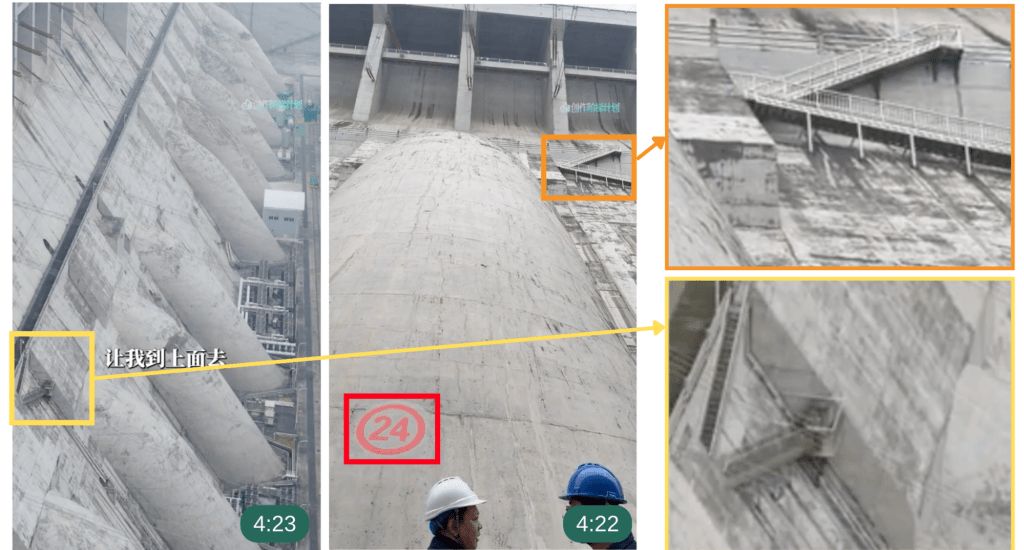
A Douyin video (archived here) posted by Zhinan Finance (直男财经), an account affiliated with the National Business Daily (每日经济新闻), provides clear visual evidence that it is a staircase, not a crack.
In footage starting at 4:13, the host introduces the right bank powerhouse, and the staircase, including its steps and handrail near the unit 24 is visible in camera shots at 4:22 and 4:23.
Historical Google Earth imagery from 2009, 2014, 2018, and 2024 shows the same feature in the same location.
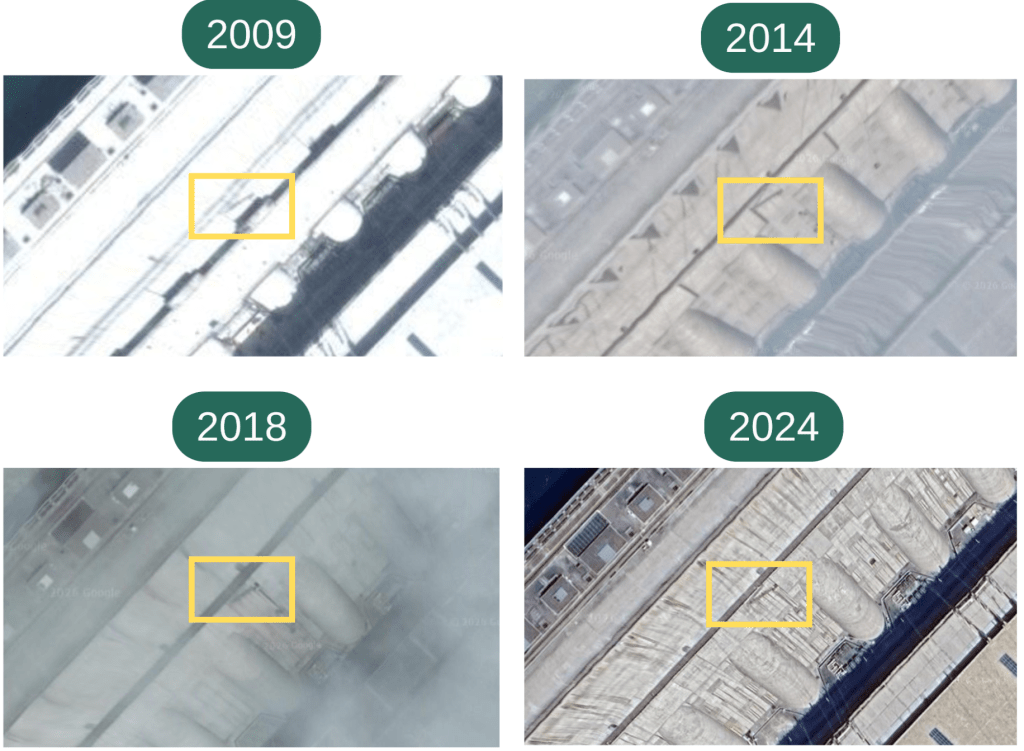
The construction of the right bank powerhouse, along with the entire Dam, was completed in 2006.
Annie Lab also found 2008 photographs on Getty Images and Flickr showing the staircase.

Galleries of the Three Gorges Dam
Further examination of the Douyin video indicates the staircase may connect to the dam’s internal galleries.
A paper by Niu Xinqiang from the Changjiang Institute of Survey, Planning, Design and Research, “Key Technologies of the Hydraulic Structures of the Three Gorges Project,” shows several galleries inside the dam body, and the elevation of two of them (highlighted in orange and yellow) matches the point where the staircase and an adjoining ladder connect.
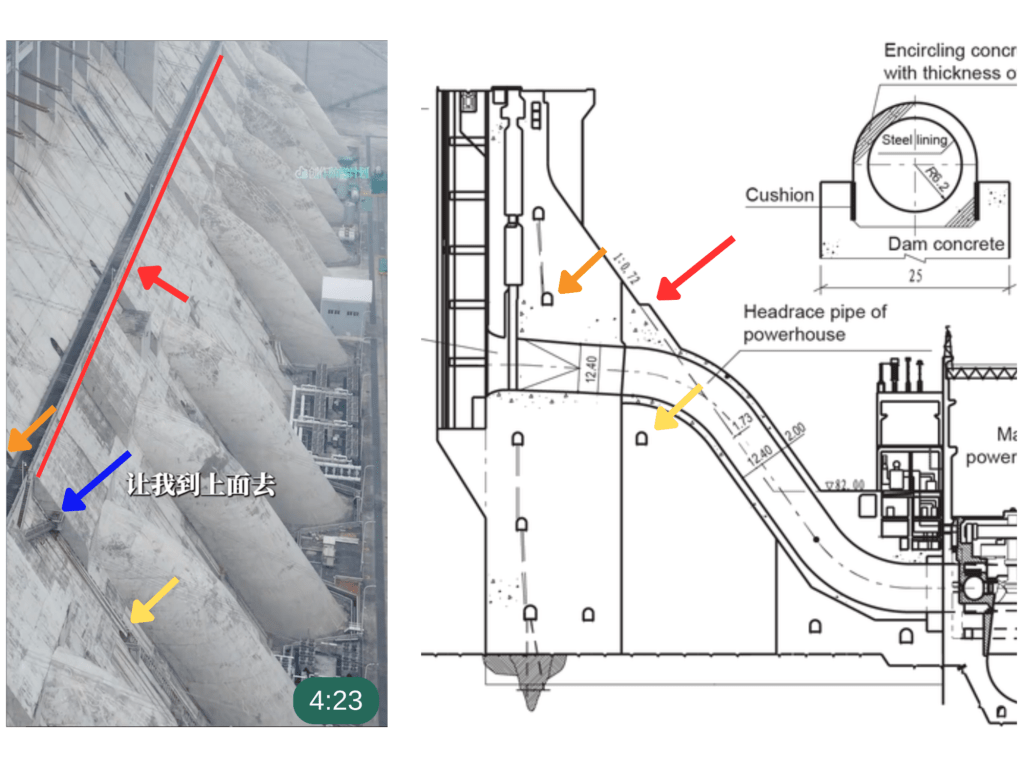
The Three Gorges Dam is built with a network of internal galleries.
According to the Design Manual For Concrete Gravity Dams, issued by the United States Department of the Interior, the common purposes of the galleries include grouting, drainage, and inspection as noted by Lee.
This YouTube video provides an example of the inspection gallery and the entrance.
Safety of the Three Gorges Dam
There has been no public evidence of structural failure, although false claims about cracks or deformation allegedly found in satellite images have spread repeatedly online for more than a decade.
China Three Gorges Corporation, the state-owned enterprise that manages the dam, said in 2019 that the dam was operating “normally, safely, and reliably”.
Remote-sensing examinations (archived here) done by Taiwan’s National Central University in 2020 found “no obvious deformation or damage” on the dam’s surface and said the structure remained stable aside from periodic elastic deformation ”likely caused by seasonal change of water level and temperature.”
Annie Lab previously debunked similar misleading claims in March and June 2020.


