Explainer: China requires real-name registration online, but not public ‘face reveals’ for VTubers
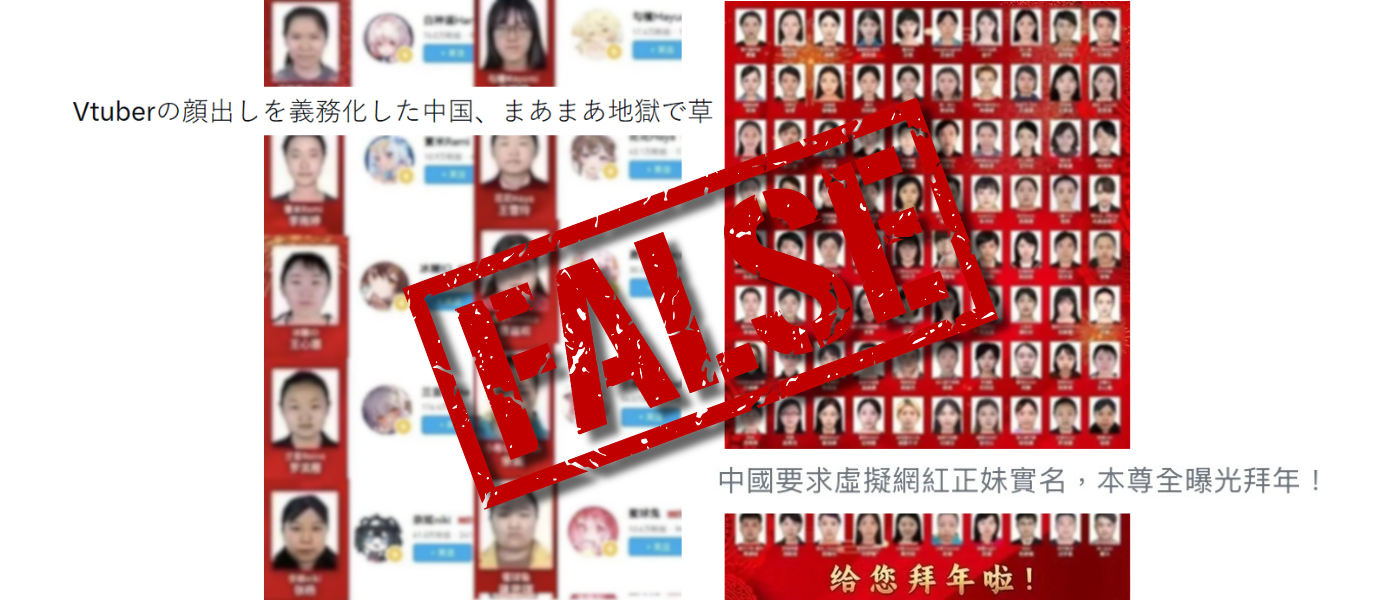
On March 23, a Japanese-language post on X claimed that China had made it mandatory for VTubers, online creators who use motion-capture virtual avatars, to show their real faces.
Two images are attached to the post. One is a poster allegedly showing ID-style headshot photos, real names, and social media handles of 100 online creators and influencers who run real-time livestream channels, often referred to as virtual streamers or VTubers.
The other image appears to match the ID-style photos to corresponding virtual avatars used by the streamers on Bilibili. The post received more than 8,200 likes, 180 comments, and 1,100 reposts within a day before the X account got suspended.
This is not the first time that these images and associated claims have circulated on the internet.
In February 2024, Taiwanese media including Mirror Media 鏡週刊, Yahoo! News, SETN 三立新聞網, and CTI News 中天新聞網 published articles claiming that China required all social media creators and influencers including virtual streamers with more than half a million followers to publicly disclose their real names and real faces.
These reports further claimed that the headshot photos on the poster were released by “the authorities.” The poster also included a new year message in Chinese, coinciding with the Lunar New Year celebration in early February 2024. Hong Kong media outlets AM730 and HK01 subsequently republished the CTI News article.
Annie Lab investigated the allegations and found that the claims are misleading on two accounts.
First, the headshots were not released by authorities; they likely originated from online sources dedicated to doxxing VTubers’ personal information. The names and other details shown in the two images have not been independently verified.
While some photos appear to match the identities of the virtual streamers based on publicly available information we examined, verifying the accuracy of the remaining details is difficult. Conducting deeper checks into such personal data could also be illegal in many jurisdictions.
Secondly, there is no law in China that requires content creators to publicly display their real names or faces. Some video platforms have introduced measures that push popular creators and influencers to show their real names, but not their faces.
Origin of headshots and names
The earliest upload of the new year poster that we could find was posted on the Taiwanese platform PTT Bulletin Board System on Feb. 4, 2024. While we cannot be certain that this upload was the original source, it is likely to be an early point in its spread that year because of its timing (the first day of the Lunar New Year in 2024 was Feb. 10).
We also learned that among the 100 streamers, only about half of them are VTubers and the others are not. For example, a vlogger named “Xinxiaomeng (-欣小萌-)” is known for dancing clips and lifestyle content. The streamer does not appear in any animated form.
In our investigation, we identified a Telegram channel that exposes private information of many VTubers, mostly from China and Japan, including the ones found in the poster. In some cases, ID card numbers, residential addresses, bank account details, and private information of close relatives are also revealed, although there is no means to verify if such details are accurate.
Due to privacy concerns, we will not identify or link to the Telegram channel or display any of the information found there.
There could be other sources that provide the headshots, names, and other personal details found on the viral poster image, but Annie Lab did not find any reliable public publications that indicate they come from the “authorities.”
In fact, it is unlikely because there is no law in China that mandates popular VTubers to display their real faces on their accounts.
Platform-led incentives for real-name display
On Oct. 31, 2023, multiple major internet platforms, including Bilibili (archived here), announced they would gradually require accounts with more than 500,000 followers to display their real names, according to the Beijing Daily. The article said the real name would appear on an account’s profile only if the account owner agreed to comply.
As of this writing, it is a voluntary opt-in feature and not mandatory. However, Bilibili’s announcement said creators who do not consent to real-name display face restrictions on traffic, revenue shares, and other benefits. This feature is available only on Bilibili’s mobile app, where a label reading “已实名” (Real-name-verified) may appear below a profile bio. Tapping the label reveals the creator’s real name.
None of the 10 virtual streamers mentioned in the X post currently displays real-name information on their account profiles, including “Lan Yin Reine (兰音Reine)”, who has more than one million followers and falls within the platform’s targetted accounts.
Streamer “Xinxiaomeng (-欣小萌-)”, who is listed in the new year poster but does not use a virtual avatar, on the other hand, displays her real name “You Xinxin (尤欣欣)”, consistent with the name shown in the viral image.

Relevant regulations
The platform measures rolled out in October 2023 were a response to a July notice by the Cyberspace Administration of China (CAC) that tightened the management of self-media (individual-run social media channels that operate outside traditional news media), according to Chinese outlet Southern Weekly.
An anonymous inside source was quoted by the newspaper as saying that no standard implementation guidelines were given to each platform.
China Media Project reported that the CAC’s “13 rules” on self-media focus on preventing impersonation (“imitative and counterfeit behavior”) and requiring platforms to act accordingly. The rule does not explicitly mention real-name display.
According to a recent study by scholars at Renmin University and Hong Kong Polytechnic University, the “13 rules” exemplify what they call “informal subcontracting,” a state–platform relationship in which responsibility for online governance is “transferred partially from the state to platform companies.”
Under this arrangement, authorities set outcome-oriented directives while platforms exercise discretion over implementation, sustained through informal mechanisms such as “negotiation, reciprocity, and flexible accountability.”
Annie Lab has reviewed relevant government regulations and announcements in China and found no law or statement requiring real-name or real-face disclosure for online celebrities, though several regulations have been introduced to strengthen the administration of influencers more broadly.
For instance, the CAC issued guidelines last December listing off-limits behaviours for online influencers (archived here), including “the spread of false information,” “fabricated experiences,” “impersonation,” and “identity fraud.”
A separate 2021 CAC regulation on social media accounts (archived here) mandates that service providers verify the legality and compliance of the accounts registered by internet users. While the regulation covers account names and profile pictures, it targets impersonator accounts. When an account’s name, profile picture or description does not match the registrant’s true identity and instead impersonates a person or entity (such as a government body, company, public institution or well-known public figure), the service provider is required to warn the user and terminate the account.
Since 2017, users in China have been required to register with their real names and have their identities verified by internet companies, according to CGTN (archived here). Article 3 of the 2022 Code of Conduct for Online Presenters (archived here) reiterates this requirement, stating that online presenters must comply with the Internet real-name system for account registration and provide valid identity information to platforms.
Last November, Annie Lab investigated a viral claim about a “new law” requiring influencers to prove their qualifications in medicine, law, finance, and education. We found the claim to be misleading because it conflated this 2022 regulation for livestreamers.


