Misleading: Rocket landing video shows a model built in US; no ‘Chinese team’ involved

On Feb. 2, 2026, a post on X claimed a Chinese civilian team had successfully developed reusable rocket technology with a video depicting a white rocket model descending vertically and being caught by mechanical arms extending from a launch tower.
The post quickly gained traction, receiving over 660 likes and 150 comments within a day, while another post featuring the same clip additionally claimed the rocket is 350 centimeters tall and was launched in China.
Similar claims also spread on Douyin, WeChat channels, and Weibo, where edited versions of the same clip collectively drew more than 1,400 likes and 600 comments.
One Douyin post from an account with 11,000 followers garnered over 2,000 likes and used hashtags such as #OutdoorTechnology and #RecyclableRockets, along with a Chinese overlay text that reads, “civilian teams have achieved preliminary success in making rockets reusable.”
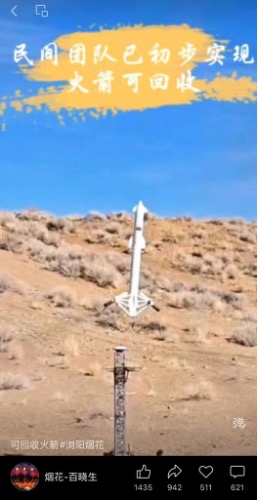
Many users seem to have taken the video at its face value and interpreted it as evidence that a Chinese private-sector team had achieved a major technological breakthrough.
However, the claim is misleading.
The footage in question actually shows a small, reusable model rocket developed and tested in the United States by an Australian engineer, who told Annie Lab he has no connection to China.
Using image search tools, we traced the clip back to an Instagram account, @astronomy4u, which had posted the same video on March 11, 2025, and credited the creator spelled as “FlyDuoDiscuss [sic].”
This account handle led to a YouTube channel named “FlyDuoDiscus”, presumably named after the Duo Discus glider, which is owned by Australian engineer and pilot Morgan Sandercock (profile archived here) whose original video titled “Landing a Model Rocket Like SpaceX” was published on Feb. 19, 2025.
Sandercock is based in Minden, Nevada, where he works as a pilot and researcher for the Perlan Project (archived here), a project focused on flying gliders into the high stratosphere.
In an email to Annie Lab, he confirmed that he built the rocket featured in the footage and said he has no affiliation or connection with any Chinese aviation or amateur rocketry teams.
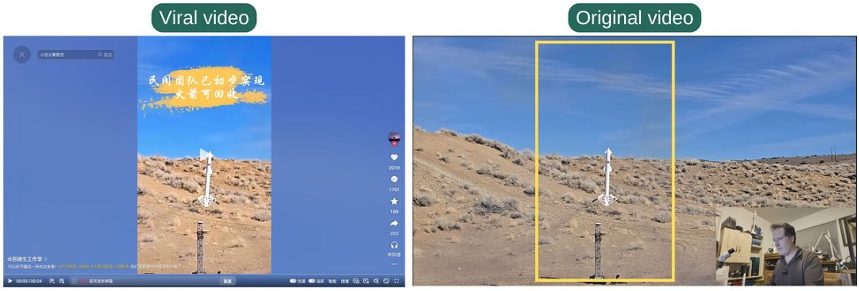
In the original YouTube video (timestamp 4:04 to 4:27), Sandercock appears in a small picture-in-picture window in the bottom-right corner as a talking head, narrating the rocket launch.
The circulating versions removed this overlay altogether, effectively obscuring the creator’s identity and making it harder for viewers to trace the footage back to its source, while adding Chinese captions that falsely attribute the technology to local civilian teams.
The model rocket is not as tall as 350 centimeters, either.
In the original video, its height only reaches roughly Sandercock’s chest when he stands next to the rocket, underscoring that it is a smaller-scale model.

Sandercock’s video notes that the rocket was designed to mimic the landing style of SpaceX’s Starship, including its tower-based “catch.”
He spent more than a year developing the project, which features a model rocket he named “Spread Eagle Rocket” and a landing structure called the “ILL Eagle Integrated Launch and Landing Platform”.
The system uses a “little GPS” mounted at the top of the rocket and a dedicated base station. The combination allows the rocket to determine its position with high precision (within a margin of 8 millimeters) by synchronizing its movements with correction data.
The misleading posts have gained traction at a time of genuine public interest in China’s progress in reusable and recoverable spaceflight.
According to Jiemian News and Xinhua News Agency (archived here and here), China has successfully completed four reusable experimental spacecraft missions as of Feb. 7, 2026.
Private firms in China have also reported their own technical milestones in reusable rocket development recently, including projects such as Zhuque-3 and Yuanxingzhe-1 (archived here and here).
These advances have been widely covered by Chinese state and commercial media including Xinhua News Agency, The Paper, and The Beijing News (here, here and here).

