Japanese speech contest winner’s remarks taken out of context, portrayed as provocative
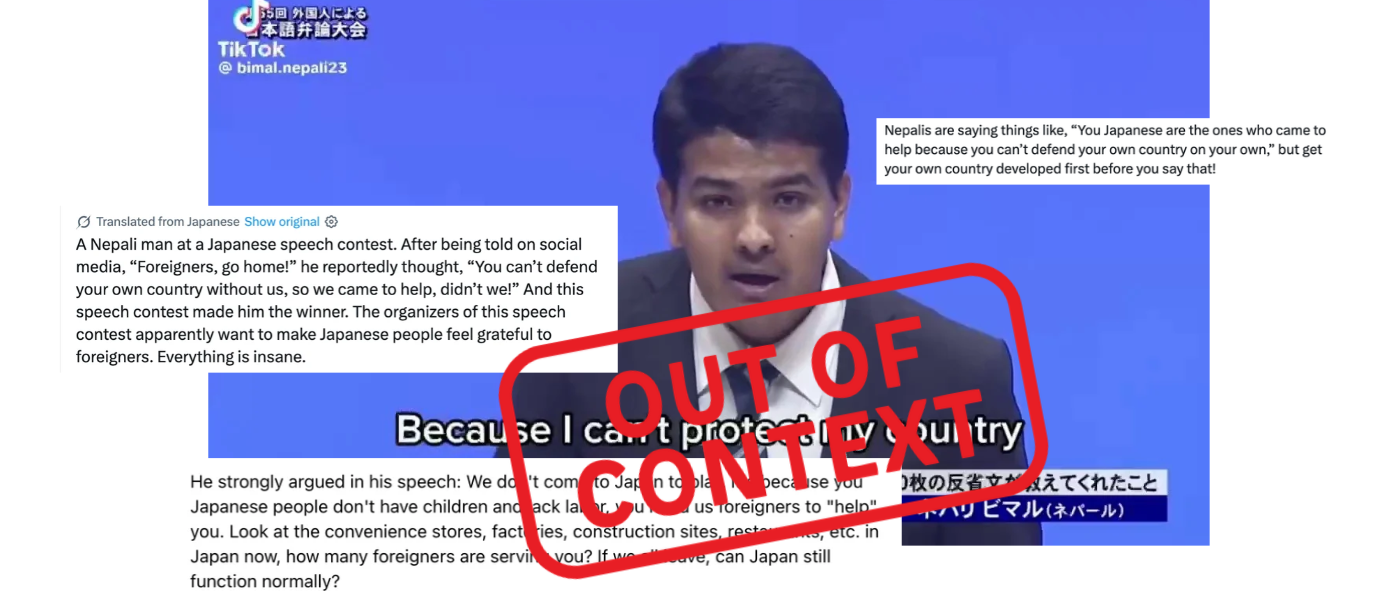
Since mid-November, a short clip taken from an award-winning speech at a Japanese-language speech contest for non-native speakers has circulated on social media.
Posts sharing the snippet suggest that a contestant from Nepal argued, rather arrogantly, that Japan needs help from foreigners because of its low birth rate and labor shortage.
One post on X has drawn 5,500 reposts and 17,000 likes. A similar Chinese-language post on Threads has received 7,400 likes. The clip drew widespread criticism, and some comments expressed anti-immigrant sentiment, including explicit calls for the speaker to go back to his own country.
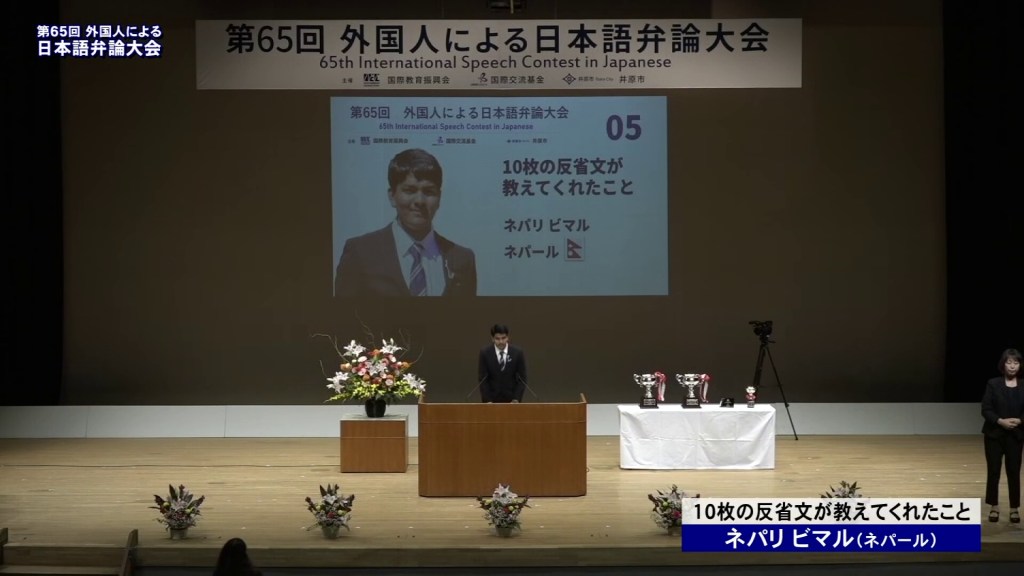
The speaker, Bimal Nepali, won the Minister for Foreign Affairs’ Award (archived here) at the 65th International Speech Contest in Japanese on Oct. 3. The contest was held at Ibara Civic Hall in Ibara, a city in Okayama Prefecture in western Japan, about 670 kilometers (415 miles) from Tokyo.
According to the organizer, the annual contest aims to provide “a forum for people from around the world to express their views in Japanese.” Speeches cover topics such as life and cultural differences in Japan, and experiences learning the language.
The viral clip takes his speech out of context. It shows only the opening of his five-minute speech, titled “10枚の反省文が教えてくれたこと (What Ten Pages of Self-Reflection Taught Me).”
In that opening, Nepali recalls his own past controversial statements and reflects on how his earlier social media remarks stirred anger online. The viral video omits that context and shows only the part where he repeated his past argument although the entire speech implies he no longer stands by it.
The speech
Annie Lab found Nepali’s complete speech (archived here) on the YouTube channel of the International Education Center, the contest’s co-organizer.
In the first minute and a half, Nepali described a video comment he recorded “in anger” after encountering hateful comments directed at foreigners living in Japan. His video, which has a highly confrontational tone, later spread across the internet.
In the speech, he quoted himself making the antagonistic statement that caused controversy earlier: “お前らこそが、自分たちだけじゃ国を守れてないから、助けに来たんだろ (We came here to help because you lot can’t even look after your own country yourselves!).”
He spent the rest of the speech explaining how the video gained a lot of attention and led him to reflect on his actions. Nepali said a conversation with his teacher, and the ten pages of self-reflection he wrote, helped him realize that retaliating against hateful posts and comments only fueled anger online.
He said he hoped to turn the “terrible mistake” into something he could treasure and ended the speech by sharing his vision of “unity in diversity” and “a Japan where everyone can feel safe and share a smile.”
The speech did not address Japan’s reliance on foreign workers or its labor shortage. It focused on his regret over how he responded to online hostility and on the lessons he learned.
The earlier video
The backlash originated in an earlier social media post by Nepali, which he referenced in his speech.
In that video, which was later deleted, Nepali spoke in Japanese and used coarse language. He argued that Japan relies on foreign workers in various sectors and the country could not survive without them.
It was reposted by another user on Jan. 21 and spread across platforms afterwards, including Facebook, Threads, and YouTube Shorts. After the contest, it resurfaced and drew renewed criticism from many Japanese social media users (archived here and here).
Mixture of earlier remarks and contest speech
The mixture of earlier remarks and his contest speech spread about a month after the event.
A Threads post in Chinese, for example, uses a screenshot of Nepali on stage with text quoting his previous remarks. It suggested that he won the contest with a speech that questions whether Japan could function normally if all immigrant workers in convenience stores, factories, construction sites, and other industries left. However, Nepali did not say these words in the contest.
Nepali himself also posted on his TikTok page an excerpt from the contest and later shared the link to it on his Facebook (archived here) on Nov. 10. Some of the circulating versions of the clip featuring his opening recollection has a watermark of his TikTok account. While his account remains active, the clip has been removed.
