Misleading: Viral WEF clip does not show proposal to ‘monetize’ air or breathing

On June 9, a video clip of a speech at the World Economic Forum was shared on X with a claim that the speaker proposed to “monetize breathing” and charge people for air and indicated that our lungs would be “owned” by unspecified corporations.
The post identifies the speaker as a “WEF executive,” implying her comments reflect an official policy directive from the organization.
The video was posted by Vivek Sen, a crypto influencer and an author at Bitcoin Magazine. The caption attributes the following quote to the speaker:
“Water, soil, and oxygen should not be infinitely accessible. They’re assets that should be included in our global economic balance sheets.”
However, that exact wording does not appear in the remarks she delivered at the forum.
Within a week, the post gained over 18,000 likes, 12,000 reposts, and 3,500 replies. Similar claims appeared on Facebook and Instagram.
The claim is not new. The earliest example of the same narrative in Annie Lab’s review dates back to an article published on June 27, 2024, in The Sociable, a technology news publication.
All these posts take the statement out of context and falsely assert that the WEF plans to monetize breathing and classify air, water, and soil as assets in a way that would restrict basic access.
Also, our investigation found that the speaker is not a WEF executive but a sustainability expert invited as a guest panelist. Her comments focused on natural capital accounting as a tool to protect the environment, and by extension the economy, rather than on imposing charges on individual users.
Origins of the clip
The viral post uses a segment from the session “Connecting Climate, Nature and Energy: Understanding Nature’s Ledger” at the World Economic Forum’s Annual Meeting of the New Champions, held in late June 2024 in Dalian, China.
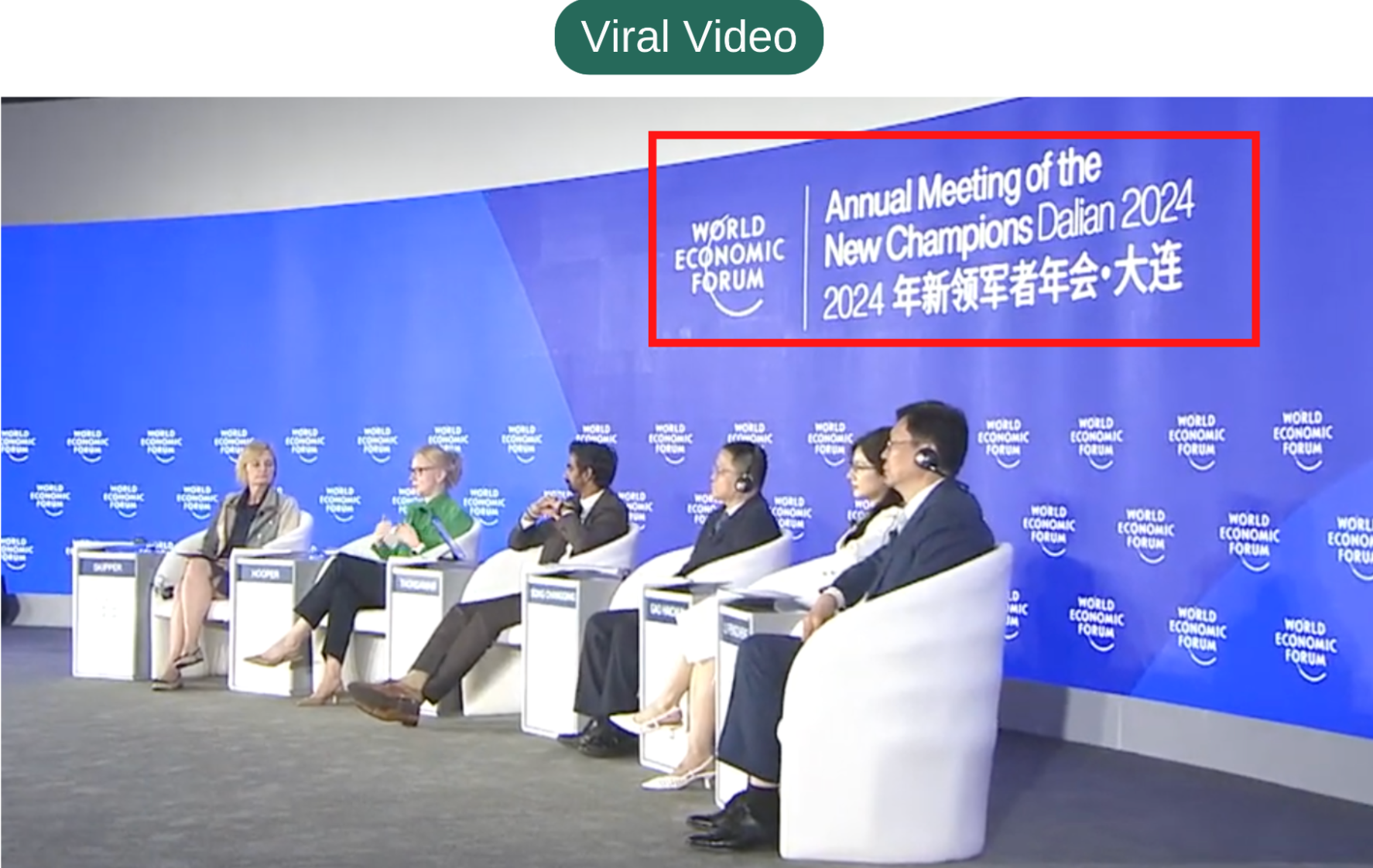
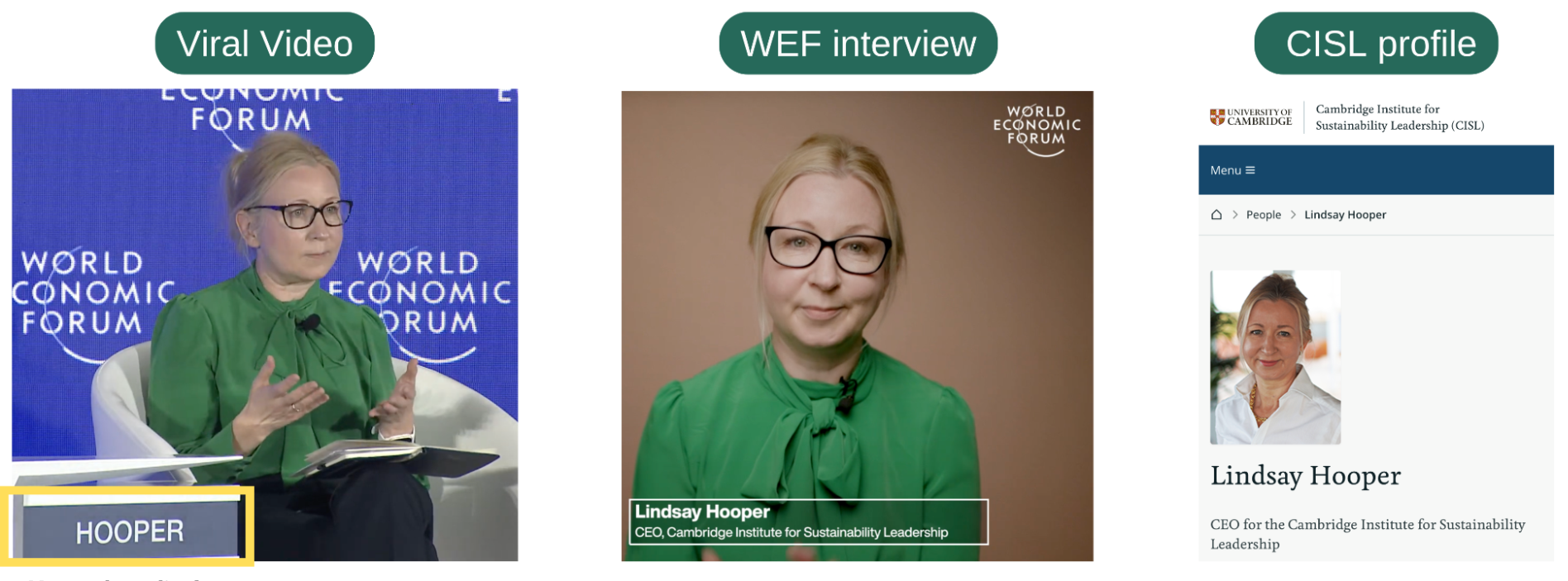
Annie Lab identified the speaker as Lindsay Hooper by cross-referencing several resources: the meeting speaker list (archived here), the moderator’s introduction in the official replay, the nameplate displayed in the live-streamed footage that reads “Hooper,” and her official staff profile (archived here) on the Cambridge Institute for Sustainability Leadership (CISL) website.
Hooper is the chief executive officer of the CISL, and she joined the session to discuss how corporate competitiveness can be aligned with environmental sustainability, particularly through better measurement of how businesses depend on and affect nature.
Hooper responded to Annie Lab through CISL’s head of media via email, saying that the viral narrative misrepresents her remarks. Her comments were about the need for businesses and financial institutions “to recognise the value of nature within economic systems, so that impacts and dependencies are properly accounted for.”
“This is about protecting and restoring essential natural systems—it is not restricting access to basic necessities such as air, water or soil, which must remain universally accessible,” she said in the email.
The viral clip appears to be drawn from a portion of the 2024 session between 8:14 and 11:09 in the official recording.
The specific quote ascribed to her in the X post — that water, soil, and oxygen “should not be infinitely accessible” — does not appear in the full session transcript.
Instead, Hooper argued that nature is a “fundamental building block” of the economy, and that treating key natural resources as if they are costless and inexhaustible encourages overuse and undermines long-term prosperity.
Quote taken out of context
During the panel, Hooper also stressed that the world “can’t do business on a dead planet.”
“If we’re going to protect natural systems, one of the solutions is to bring nature onto the balance sheet,” she said.
She went on to say governments, companies, and financial institutions should incorporate nature-related assets and risks into their traditional economic and financial reporting frameworks, so that “capital is directed to activity that’s good for nature and away from business that’s fundamentally damaging the planet.”
While Hooper’s full remarks span five minutes and five seconds, the viral post isolates only the first two minutes and 55 seconds, stripping away the second half of her speech.
Natural Capital Accounting
The concept Hooper promotes in the forum is called natural capital accounting, an increasingly common approach in government and business.
According to the European Commission, natural capital accounting measures how the quantity and condition of ecosystems change over time and systematically incorporates the benefits and economic value of the services they provide into standard accounting and reporting systems, such as the United Nations’ System of Environmental-Economic Accounting (SEEA).
In 2024, the Commission adopted new rules and introduced new account modules, including ecosystem accounts and forest accounts, to compile more detailed data from European Union member states. The UN says more than 30 countries currently produce ecosystem accounts, and many others are piloting natural capital accounting to inform policy, investment and biodiversity targets worldwide.
According to its website, CISL works with businesses and financial institutions on natural capital accounting and regularly publishes reports and tools on net‑zero corporate roadmaps, sustainable finance, and climate risk and insurability.