Analysis: Viral ‘broken-leg women’ video falsely links charity footage to fake ‘marriage custom’
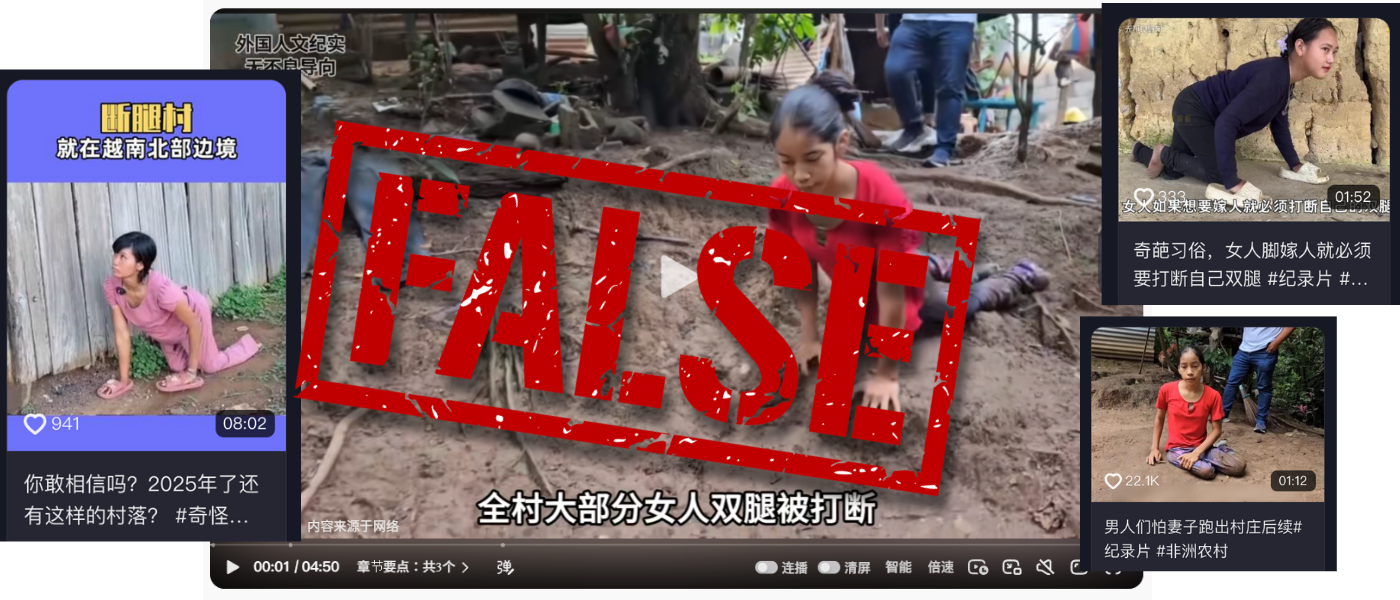
A Douyin video uploaded in October 2025 claims to document an unnamed rural village in Southeast Asia where women’s legs are systematically broken to prevent them from escaping forced marriages.
The four-minute clip, produced in a documentary style, focuses on a supposed victim identified as “Xiaocui (小翠).”
The male narrator alleges that Xiaocui was sold into marriage with a middle-aged man for financial reasons. The narrator says she had her legs broken by her husband after a failed escape.
The video further portrays her as trapped in confinement, forced to serve her husband and bear children. It claims that most women under 20 in the village suffer similar mobility problems.
Set against a backdrop of muddy grounds and dilapidated village homes, the video shows several women with visible physical disabilities crawling through impoverished, remote surroundings.
It has attracted more than 13,000 likes, 1,500 comments, and 18,000 shares on Douyin, with most comments expressing shock and sympathy, though some users question whether the “custom” is real.
How the footage spread

Through keyword and reverse image searches, Annie Lab identified similar claims and narratives using the same clips on Bilibili, YouTube, Facebook, X, and Instagram (Instagram reels could not be archived).
On Douyin, a search for the phrase “断腿女人村” (“village of broken-leg women”) returned dozens of uploads from different accounts, with many attributing women’s disabilities to a wedding “custom.” Some posts label the scenes as African, while others place them in northern Vietnam.
The storylines also vary. Some describe the leg injuries as a voluntary “dowry” or “sacrifice” proving women’s life-long loyalty. One NetEase video bolsters this claim with unsubstantiated statistics about the supposed village. Its narrator asserts that one woman in the area “becomes disabled every 72 hours” and that the disability rate is “270 times higher than the national average,” citing the village’s annual income, school enrollment, and the distances between the confined woman’s home and the local well, without mentioning information sources.
What Annie Lab found
Our investigation into the Douyin video found no evidence supporting the claim of a systematic practice of breaking women’s legs.
Three of the four women featured in the clip can be traced back to video interviews in which they said pre-existing medical conditions caused lower-body paralysis.
These original videos were produced and shared by content creators to raise awareness and donations, not to document domestic abuse.
The fourth woman remains unidentified, but the footage involving her appears staged.
Woman 1: Nhom in Binh Phuoc, Vietnam
Reverse image search results linked the first woman, who appears most frequently in the viral video, to two YouTube channels whose creators had visited her home.
She is identified as Nhom (“Nhôm” in Vietnamese) and often seen crawling through a dilapidated wooden hut alongside her young daughter.
Several clips featuring Nhom in pink clothing in the viral video were taken from the footage posted on May 14, 2025, by the YouTuber Thay Giao Dong (“Teacher Dong”), at timestamps 15:06, 0:03, and 1:51 (in the order of their appearances in the viral video).
In the version circulating on Douyin, some frames were cropped to remove contact details that appeared in the YouTubers’ original footage, obscuring the context that this was a charity appeal.
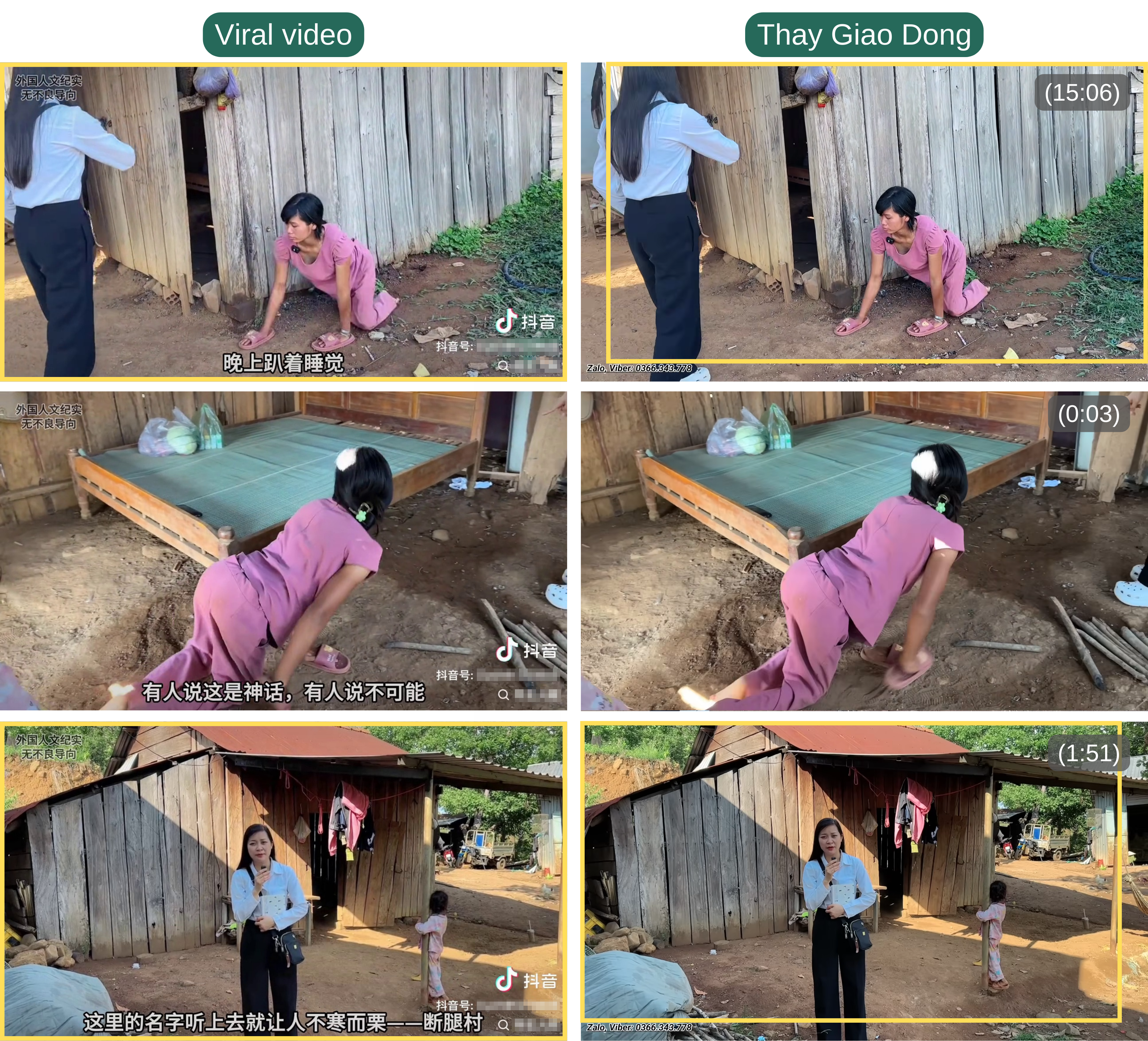
Shots showing her in a pale yellow shirt were harder to trace directly, but a video posted on April 4, 2025, by another YouTuber, My Xuan, contains identical scenes found in the viral video at 0:44, 4:40, 3:27, 5:55, and 22:36, indicating they were filmed simultaneously during the same visit.

A Vietnamese freelance journalist, Buu Nguyen, helped us confirm that the woman, now 22 years old, reportedly contracted poliomyelitis (polio) at about three and a half years old, leaving her permanently paralyzed from the waist down.
In the YouTube video interview, Nhom said she was deceived by an older man who abandoned her after she became pregnant. She gave birth to her daughter at 17 and remains unmarried, living in a leaky house in Bu Dang District, Binh Phuoc, in the southeast region of Vietnam.
The fundraising videos featuring Nhom have reportedly succeeded in securing donations for an electric wheelchair and later helped the mother and daughter relocate to a new, safer housing.
Woman 2: Lau in Lao Cai, Vietnam
A second woman in the viral compilation, known as Lau (Lầu in Vietnamese), lives in a different region in Vietnam and has no connection to Nhom.
She appears in black clothing, navigating the muddy yard of an old clay-walled house, with visible atrophy in both her hands and feet.
Her scenes were traced to a video posted on Nov. 11, 2024, by the YouTube channel Vung Troi Tay Bac. She appears at the beginning and again at 9:46.
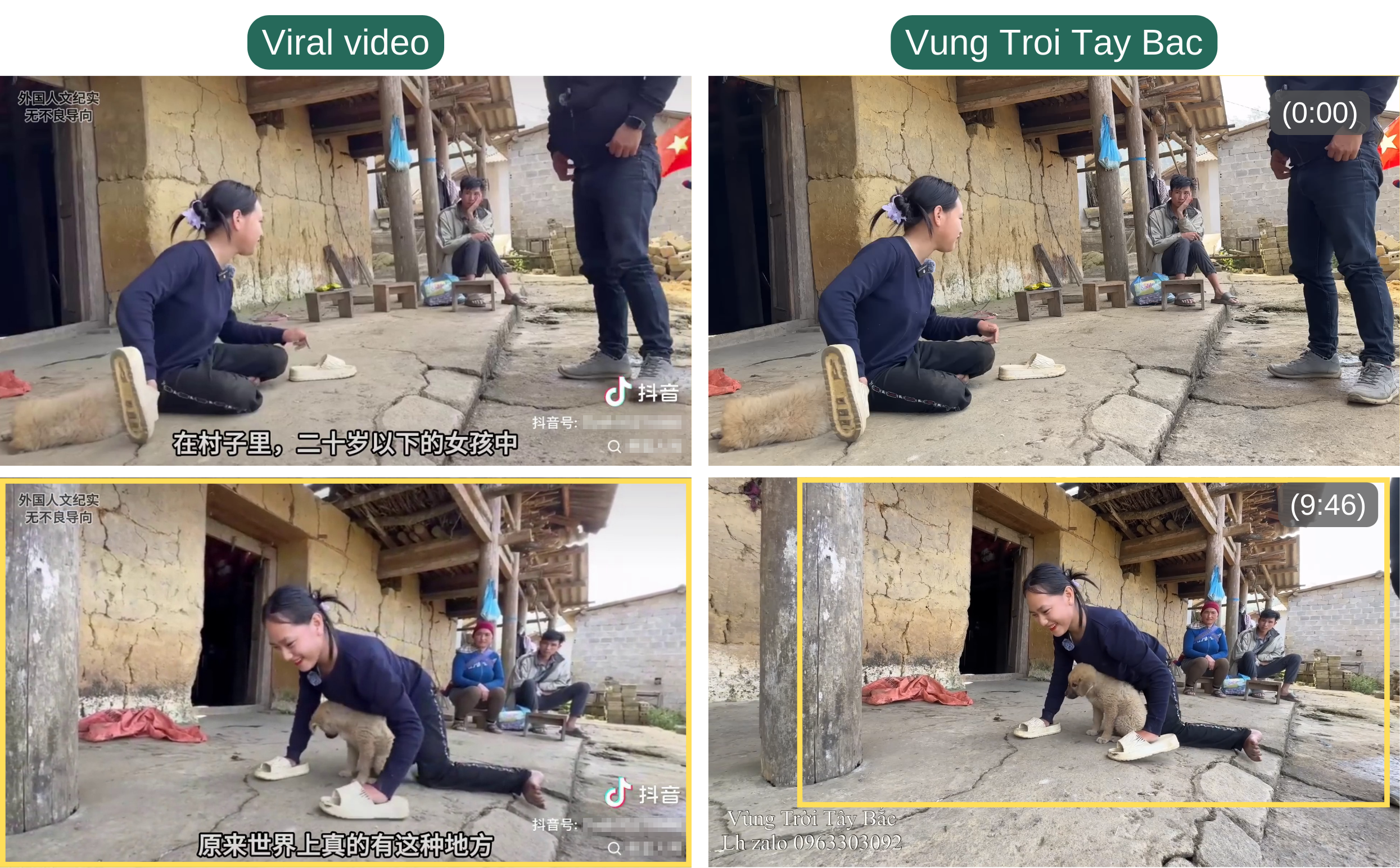
A translation of the original content checked by Nguyen states that Lau’s mobility problems began after a severe fever when she was two or three months old, though the precise diagnosis is not disclosed.
The footage, shot in late 2024, describes her as 16 years old, unmarried, and living with her family.
The video does not name her location, but visual clues point to northern Vietnam. A motorcycle parked in Lau’s home later appears being ridden by her mother in another video, and the license plate shows the regional code “24.”
The number is assigned to Lao Cai province, according to the country’s vehicle registration system (archived here). Situated near the Chinese border in northwest Vietnam, Lao Cai is at the opposite end of the country from Binh Phuoc, where Nhom lives.

Woman 3: Glendy in Guatemala
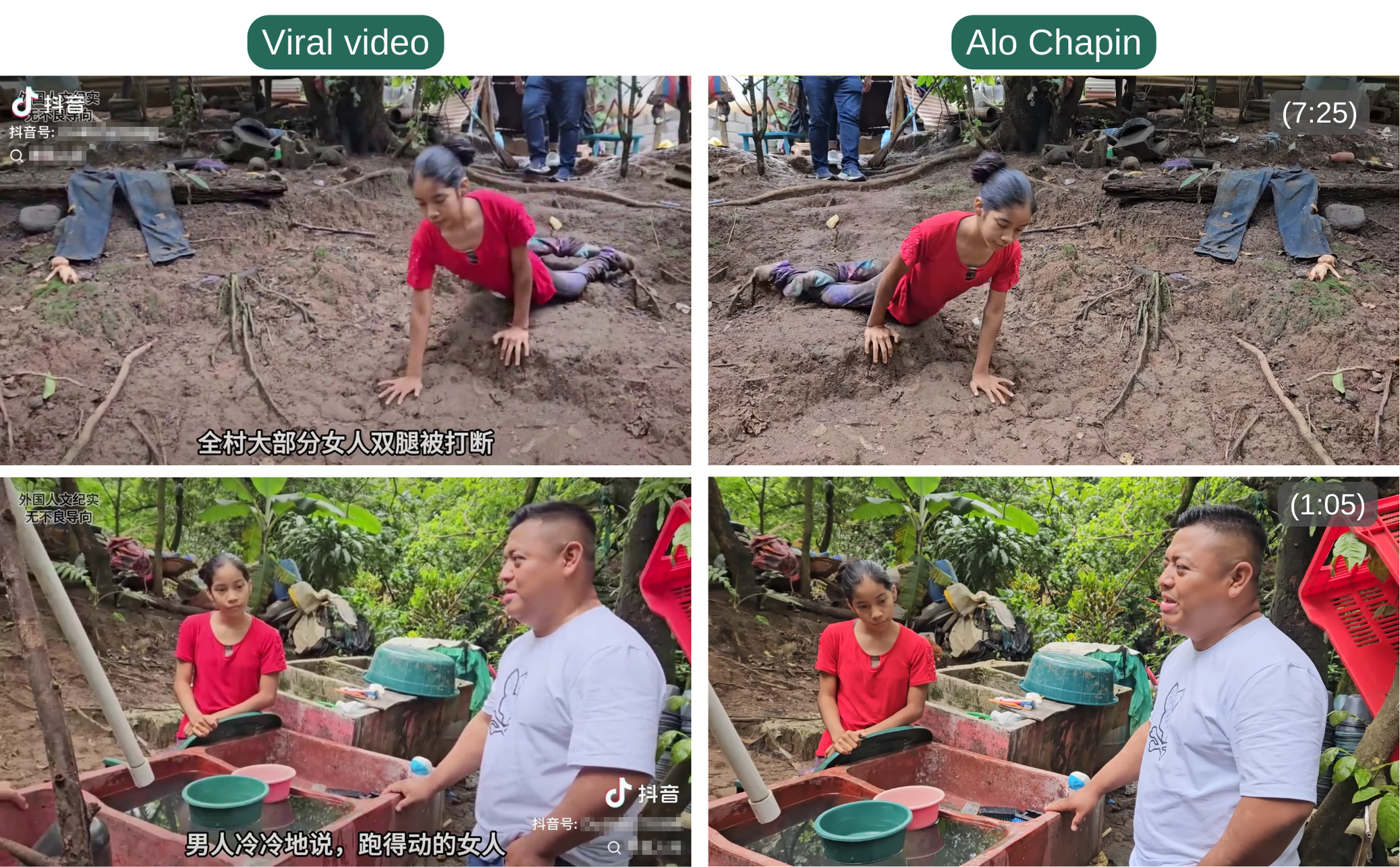
The young girl in a red top who appears briefly near the start and again later in the viral video is Glendy, a teenager from Guatemala in Central America. She suffers from chronic paralysis and crawls across uneven ground around her home.
Her story has been featured by Guatemala-based YouTube content creators, Alo Chapin and ASI ES GUATEMALA, who have used their channels to solicit donations for her medical care and better living conditions.
The two scenes used in the Douyin compilation were lifted from the video (at 7:24 and 1:05) published by Alo Chapin on July 20, 2024.
To verify details from the interview videos, Annie Lab consulted Ana Prieto, an Argentinian journalist and digital researcher, who is fluent in Latin American Spanish.
Prieto reviewed multiple videos about Glendy and noted that in a recent video published by ASI ES GUATEMALA in January 2026, Glendy was taken to a medical facility where doctors recommended an MRI scan to confirm a suspected spina bifida diagnosis.
In the video, a family member describes Glendy having a lump on her lower spine since birth that continued to grow and cause pain, symptoms consistent with spina bifida, which the Mayo Clinic lists as causing “weakness or lack of movement in the legs.”
Glendy is shown living with her parents at age 13 in 2024 footage. In another Alo Chapin video posted on Aug. 27, 2024, she appears with the YouTuber at a local eatery in Nueva Concepción, a town in southern Guatemala, a location we verified by geolocating a business across the street (it appears at the 10-second mark).
A follow-up video published two days later shows the creator handing over a signed property transfer document to Glendy’s family after reading some of its details aloud.
Annie Lab has contacted both channels for more information about Glendy’s condition but has not yet received a response.
Woman 4: Unidentified, but likely staged
The viral video also includes multiple scenes of a woman wearing a red checkered shirt with bandages on her knees. Although Annie Lab was unable to determine her identity, the variety of camera angles and polished editing techniques suggest staged and fictional sequences rather than spontaneous documentation of a disabled person’s daily life.
The compilation shows the woman being carried to a bed, lying in apparent pain, and later crawling on the floor while a voice-over claims she was beaten and left without treatment after trying to escape.
We located several other clips featuring the same woman and the same house with a bamboo structure (here, here, here, and here).
These videos were posted on Douyin and YouTube between Nov. 6, 2024, and Mar. 18, 2025, including one that contains identical scenes at 0:16 and preserves the woman’s original Vietnamese dialogue.
In this version, according to Nguyen’s translation, she calls out “Có ai không?” (“Anybody here?”). A storyline of the videos featuring her centers on a mother and son allegedly abandoned by her unfaithful husband.
Further uploads Annie Lab has gone through show the same woman in different, possibly scripted, situations, consistent with a “daily life” series about single mothers in poverty, a popular genre in Vietnamese online video (screenshots below).


The Douyin account and monetization

The October 2025 upload comes from a prolific Douyin account that claims to present documentary-style glimpses of rural life in Southeast Asia, consisting of rather sensational, stereotypical depictions, as far as Annie Lab can review.
The channel, which has nearly a million followers and more than 12 million likes, posts roughly one video a day.
Our review of the channel suggests the account heavily relies on content scraping, as numerous videos appear to be re-uploads of other creators’ material without proper attribution.
Some iterations of its content explicitly flag the footage as fictional entertainment, but others, such as the “broken-leg women” compilation, carry a label that reads “Foreign cultural documentary. No negative implications. (外国人文写实/无不良导向)”
The profile’s Douyin Store displays two product links, and the video in question includes a pinned comment promoting a “mobile top-up (话费充值)” service. By clicking the link, the viewers can earn small rebates or coupons toward their phone bills. Meanwhile, their clicks generate revenue for the creators.


Recurring narratives
Previous fact checks show that the “leg‑breaking village” story is part of a recurring pattern of misleading claims that exploit real disabled individuals to depict supposedly “barbaric” customs.
In November 2025, a Douyin account called “动物园巡逻员” (“zoo patroler”), a channel known for debunking online misinformation with over 460,000 followers and 6.6 million likes, published a video tracing several segments of the viral clips used in the “broken-leg women” compilation back to their original sources on YouTube.
In early 2025, MyGoPen and the Taiwan FactCheck Center debunked videos claiming the existence of a “no-arm village” in Vietnam where men are reportedly required to sever their arms as a marriage dowry. The footage actually depicts a charitable mutual-aid network in Long An Province called “The Second Family,” made up of men who lost their arms in industrial or electrical accidents.
HKBU Fact Check similarly refuted a claim that women were amputating their legs to make cured meat. Their investigation found the video footage was taken from a documentary about ethnic groups in Ha Giang, a city located on the Lo River in northeast Vietnam, who follow the traditional custom of preserving limbs lost to illness or landmines for future burial to ensure their bodies can be interred “whole.”
The HKBU investigation noted that the viral version of the video used deceptive captions and editing to suggest that the video presenter was eating a human limb when he was actually served smoked buffalo meat by the family he talked to.
These fact-checking stories revealed a pattern. Some footage gets repeatedly misappropriated and repackaged by altering the subjects’ location, medical history, personal background (such as the nature of their disabilities), and other details to build shocking false narratives about foreign cultures.
[Correction on Jan. 16] An earlier version of this article incorrectly stated that Glendy had already undergone an MRI scan and that she personally described her symptoms in the video. The article has been updated to clarify that an MRI was recommended by medical professionals following her facility visit, and that a family member described her spinal condition.


