Explainer: Pet ID cards in HK aren’t official but fun; We got our own, too

Like pet, like owner. Photos of Hong Kong’s resident ID cards for pets have circulated online for years, with some social media users mistaking them as official certificates of pets’ identity.
They often commend Hong Kong for taking animal welfare seriously and share the images, prompting fact-checking organizations to investigate the claim.
A U.S. media outlet, Lead Stories, for example, debunked a myth that Hong Kong provides an official ID card, lifetime health insurance, and food subsidy for pets in 2021 (archived here).
Arab fact-checking platform Misbar clarified that the pet identity card is a decal sticker available for purchase through a Hong Kong business’s Facebook page (archived here).
In October, Hong Kong Free Press also reported that images of pets’ HKID cards have gone viral again this year, noting that it is a novelty card you can buy and not an official identification card.
While Hong Kong’s government-issued identity card for citizens is a daily fixture of life in the city, pet ID cards are not.
The novelty item is available for purchase through the online shop of the Society for the Prevention of Cruelty to Animals (SPCA), a nongovernmental organization.
Other vendors also sell customized pet ID cards made to order on e-commerce platforms like Carousell and Taobao.
To see what the long-running fuss is all about, Annie Lab staff commissioned pet IDs for our beloved pets: Ruby, a three-year-old Shiba Inu, and Gu-Gu, the six-year-old tabby cat.
Getting Ruby’s ID From SPCA

On the SPCA’s online shop, customized pet “IDs” cost HK$70, excluding shipping. Customers can expect to receive their product two to three weeks after placing an order.
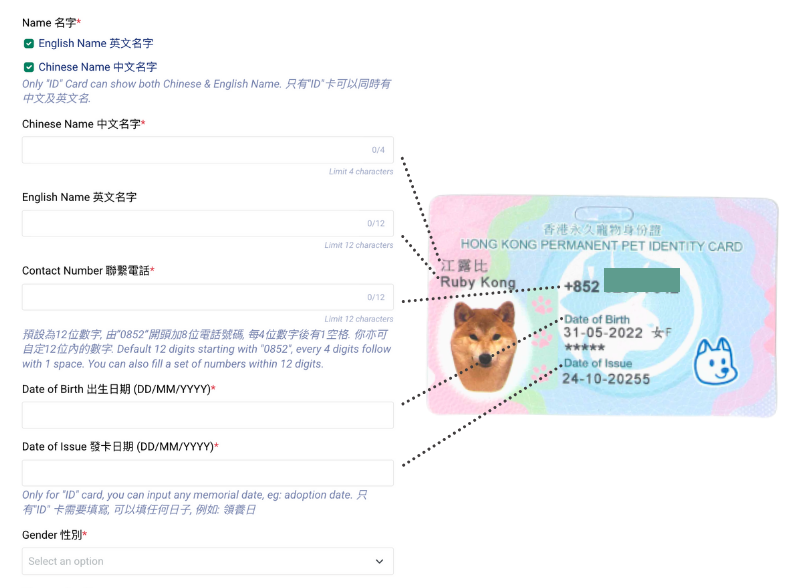
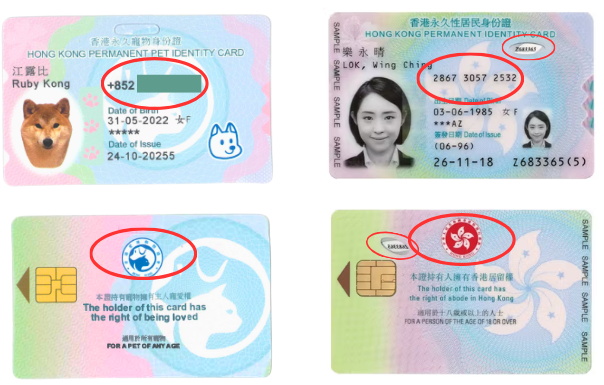
The pet ID designed by the SPCA closely mirrors the layout of Hong Kong’s latest generation smart identity card for citizens.
Customers fill in their pets’ details such as their English and Chinese names, and date of birth along with a photo to upload. The pet owners may choose to provide their contact phone number to replace the mock ID number, presumably for emergencies.
They can also customize photo orientation and select colors for a keyring to attach to the ID card.
The SPCA’s online shop also sells customized “credit cards” for pets. When customers select the “UnionPet” option instead of an ID and fill out pet information, the finished card features the owner’s contact number in place of a bank account number, with the pet’s date of birth replacing the expiry date.
Shopping elsewhere for Gu-Gu’s ID
Another option for pet parents is individual sellers on Carousell or Taobao, where delivery typically takes four to five days after ordering.

Gu-Gu’s pet ID came from a Taobao store, costing 65 yuan, about HK$71.
Our staff ordered one from Taobao. She provided details including name, date of birth, gender, and a made-up identity card number to be printed on the finished product.
On these platforms, customers can also use the chat function to communicate directly with vendors and further customize pet photos and card designs.
What Hong Kong actually does for pet ID
The government’s actual pet identification system centers on a licensing requirement for pet dogs.
Dogs over five months old must be licensed and microchipped through the Agriculture, Fisheries and Conservation Department (AFCD), as part of a rabies prevention program.
The implanted microchip carries a unique identification code that allows authorized parties to access the dog owner’s contact information if the pet is lost or abandoned.
The microchip is valid for the dog’s lifetime. Owners must vaccinate their dogs every three years to renew licenses (which costs HK$80). Failure to renew risks a fine of HK$10,000, according to 1823.gov.hk, the Hong Kong government information portal.
As of 2024, 158,000 dogs in the city have been microchipped and licensed.
However, a 2021 Office of the Ombudsman report (archived here) identified gaps in AFCD’s management of license renewals, noting that 68% of dogs abandoned in the previous year had expired licenses or none at all.
Among stray dogs captured without microchips, only one-tenth were successfully returned to their owners.
Cat owners, meanwhile, face no licensing requirement, though all cats sold by licensed animal traders must be microchipped beginning 2024.
These regulations aim to tighten control and safeguard public health and animal welfare, according to the authorities. Government figures show more than 760 cats with microchips were sold through licensed traders between April and December 2024.
Both dog and cat owners must apply for a special permit from the AFCD before bringing animals into Hong Kong. Quarantine and import requirements vary by place of origin, with current arrangements also covering pets from mainland China.
