Analysis: No new Chinese law on influencers; livestream regulations took effect in 2022
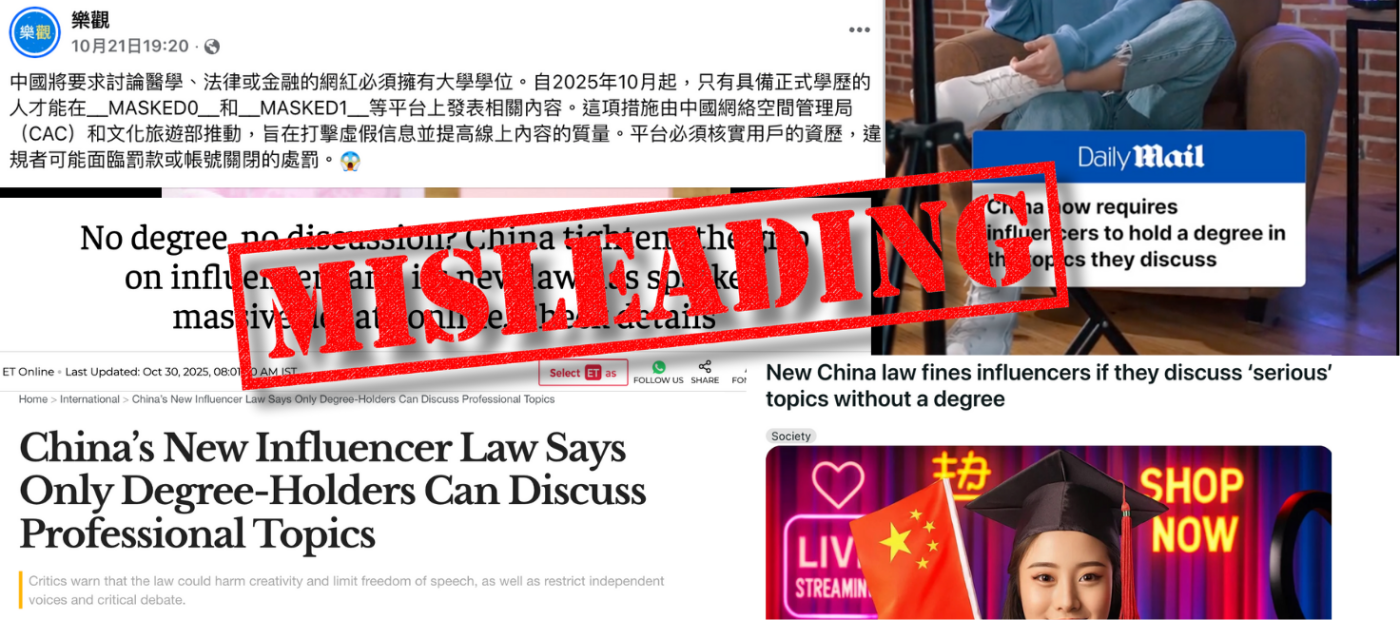
Since late October, various news media outlets and social media posts have claimed that China recently passed a “new law” requiring social media influencers to prove their qualifications before discussing specialized topics such as law, health, finance, and education.
These claims spread widely across social media platforms including X (here, here, and here), Instagram, Reddit, Facebook (also here) and others. For example, posts with similar claims attracted 670,100 likes and 6,874 comments on TikTok, along with 5,800 likes and 1,300 reposts on X, and 60,500 reactions on Facebook with 3,200 comments and 10,000 shares.
News media outlets such as CNBC TV 18, The Economic Times, Daily Mail and others also reported about the alleged new law. However, despite widespread coverage, none of the reports identified the specific regulation in question. Annie Lab found three variations in how the requirement was described across different posts and news reports:
- Influencers must hold a relevant university degree (example);
- Influencers must possess a relevant professional credential, such as a university degree, recognized training, license, or certificate (example); or
- Influencers must obtain government-recognized certification (example).
Most posts alleged that the Cyberspace Administration of China had introduced a new law that took effect on Oct. 25, with some claiming violation could result in fines of up to 100,000 yuan (see here).
However, a review of China’s legislative documents shows that no new law has been enacted regarding influencers’ professional credentials.
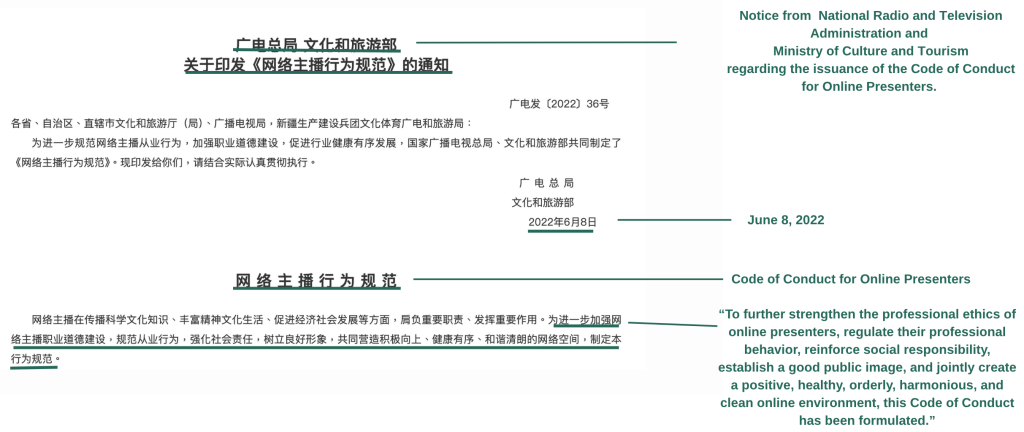
Meanwhile, an existing regulation issued in 2022, the Code of Conduct for Online Presenters, imposes similar credential requirements for livestreamers.
Not new: 2022 Code governs professional qualifications
Annie Lab reviewed documents from the National People’s Congress Standing Committee (NPCSC), China’s top legislative body, and the Cyberspace Administration of China (CAC), the primary internet regulator; we found no record of any law or policy enacted or taking effect in October 2025 that imposes new credential requirements for online content creators.
Keyword searches in Chinese using terms including “social media influencers (网红),” “specialized topics: medical, law, finance, education (特定议题:医疗、法律、财经、教育)” and “qualifications (专业资格)” all resulted in showing the “Code of Conduct for Online Presenters,” or 网络主播行为规范, issued on June 8, 2022 by the National Radio and Television Administration and the Ministry of Culture and Tourism, not by the CAC.

The Code applies specifically to “online presenters”, but not all influencers. This distinction is important, as the viral claims suggested the requirement applied to all social media influencers.
Online presenters are defined by the Code as individuals who provide online performances or audiovisual program services such as livestreamers and broadcast hosts.
Article 13 of the Code states that a qualification verification is required when livestreamers discuss professional topics such as medicine and health, finance, law, and education.
The policy has been in place since 2022 to regulate “the ethics, conduct, public image, and social responsibility” of online content creators. No updates or amendments to this regulation have been issued.
New rules for medical advice and health influencers
On Aug. 1, the CAC jointly issued a notice about new regulations concerning medical advice along with the National Health Commission (NHC) and the State Administration for Market Regulation (SAMR).
The South China Morning Post reported that healthcare practitioners and related personnel face stricter requirements when sharing medical science information on social media under the new “Guidelines for Regulating Medical Science Self-Media Behaviour,” which apply to independently generated content posted outside traditional media channels.
The guidelines provided clearer instructions for social media platforms on how to verify account credentials and authenticate content.
Bans, Not Fines
In 2022, the National Radio and Television Administration stated in a press briefing that content creators who repeatedly or severely violate Article 13 of the Code will face broadcast bans and be placed on a “blacklist” or “warning list.”
The Code does not explicitly stipulate monetary fines for breaching the requirements. It only states in general terms that offenders may be liable for criminal offences (“依法追究刑事责任”).
While the amended Cybersecurity Law can impose fines of up to 100,000 yuan, there is no evident link between the Cybersecurity Law and the Code. The stated fines were newly introduced during the NPCSC meeting on Oct. 28, 2025.
According to state broadcaster CCTV’s report on Oct. 11, 2025, the Beijing Municipal Cyberspace Administration has also instructed streaming platforms to block accounts impersonating lawyers, doctors, or financial experts. The Administration publicly released the names of the banned accounts.
CAC record also reveals that the government enforced the Code during the 2024 national campaign “Clear Action,” or “清朗网路直播领域虚假与低俗乱象整治.” Livestreamers discussing specialized topics without proper qualifications were charged with online impersonation.
Professional qualifications required, degrees not mandatory
Article 13 of the Code does not mandate university degrees.
It requires livestreamers to hold “relevant professional qualifications (相应执业资质)” when producing content that “demands higher standards (较高专业水平)” of expertise, but it does not specify that influencers must hold a university degree.
The Code also requires livestreaming platforms to review and keep records of these qualifications, though authorities have not imposed a standardized threshold for acceptable proof.
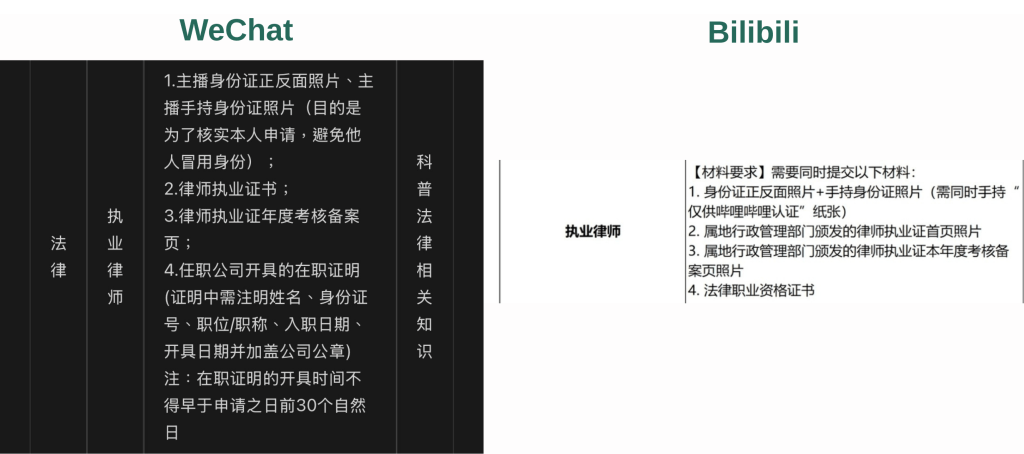
WeChat, one of China’s largest livestreaming platforms, does not require proof of a university degree. According to its livestreamer entry requirements (“准入标准”) for legal, health, and financial topics published in 2023 and 2024 (archived here, here, and here), livestreamers must instead obtain an authorization from the platform by providing specified certificates in law, medicine, or finance, which do not necessarily include university degrees.
In some categories, requirements go beyond academic qualifications. For instance, health category accounts registered as “doctor” or “nurse” must demonstrate employment at a Level 3 Grade A hospital, China’s highest tier in its hospital classification system. Accounts registered as “medical researchers” must show they have received national-level medical awards and honors.
Bilibili, another major livestream platform, also does not require proof of a university degree. Its list of acceptable documentation includes certificates and written consent from the relevant institution.
WeChat and Bilibili’s requirements for legal-themed accounts differ slightly by platform, but neither includes a university degree as a mandatory credential.