Analysis: Narratives on ‘botched’ suicide prevention messages at Seoul’s Mapo Bridge
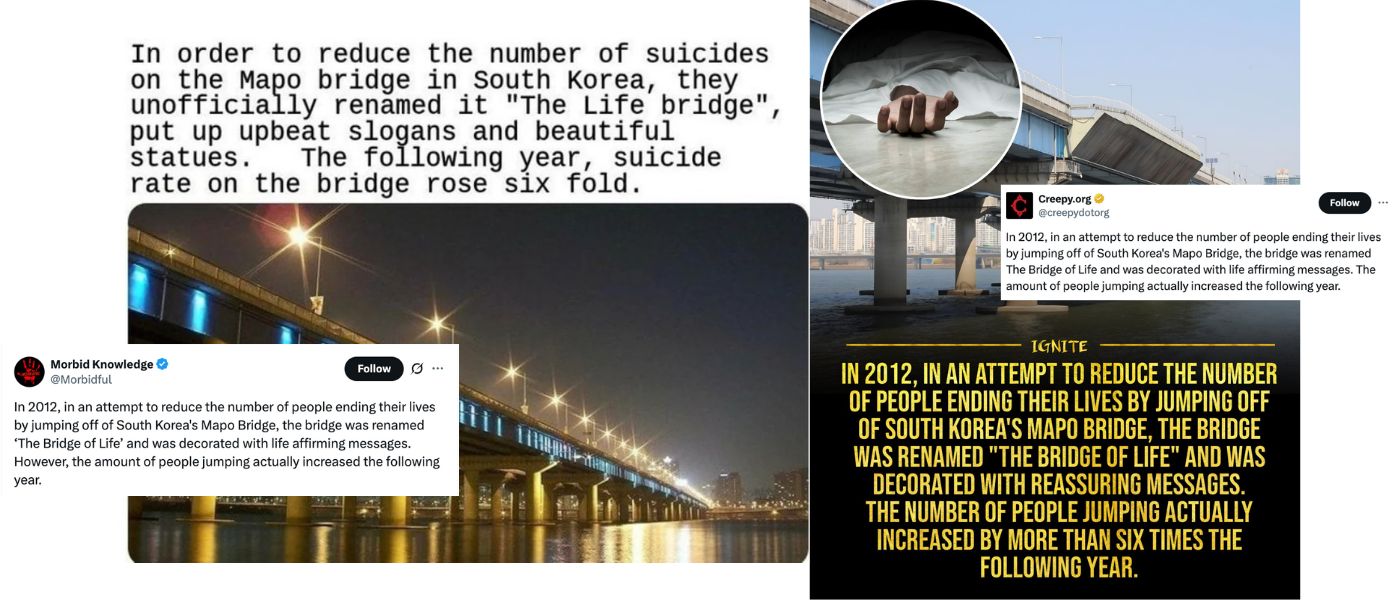
A decade-long online claim circulating in South Korea alleges that a suicide prevention measure on a bridge in Seoul in 2012 backfired dramatically, leading to a sharp increase in suicide attempts in the following year. The claim and similar narratives are still occasionally shared in 2025.
For example, a Facebook post in September this year claims that due to “The Bridge of Life” campaign at Mapo Bridge, “the number of people jumping actually increased by more than six times” in 2013.
Similar posts have appeared on Reddit, Instagram, and X, with the earliest one Annie Lab could trace back to 2014. Two Reddit posts (here and here) have garnered more than 40,000 likes together over the years.
However, the allegation that the campaign ‘caused a sixfold increase’ in suicide attempts is not entirely accurate. In our analysis, multiple factors contributed to the increase in reported cases of attempts.
What is ‘Bridge of Life’ campaign?
Records from 2007 to 2012 show that out of the 1,301 suicide attempts in the Han River, 108 occurred at the Mapo Bridge, resulting in 48 deaths. According to Yonhap News, this gave the bridge the highest suicide attempt and death rate in South Korea during the five-year period.
The suicide prevention campaign, a project by Samsung Life Insurance and a marketing company, Cheil Worldwide, was introduced in September 2012 to counter the bridge’s grim reputation as the “bridge with the most suicides” (archived here).
The campaign included uplifting messages on the railings that light up as they detect motion when a person passes by, and a 1.8-meter-tall brass statue depicting one person holding another (archived here).
The supposedly uplifting phrases written on the railings of the Bridge of Life were selected through a public contest. However, there was skepticism about this process, as some of the messages were considered inappropriate (archived here). Ensuing controversy led the city to remove them in 2015 (archived here).
In 2019, Professor Kwak Geum-ju of Seoul National University’s Department of Psychology commented to Money Today, a prominent economic news outlet of Korea, that the process involving a contest was “problematic.” Instead, she suggested a better approach would be to commission a team of experts to develop the phrases based on scientific evidence (archived here).
South Korea’s mental health experts, who co-authored an academic paper published in the Journal of Public Health Policy in 2019, noted that the campaign attracted more people with suicidal thoughts as the bridge became famous, increasing the number of suicide attempts there (archived here).
Prevention, detection, and rescue efforts
Amid the skepticism, the Seoul metropolitan government, along with the Bridge of Life campaign, initiated the operation of a CCTV video surveillance management system in 2014.
According to the Korea Urban Environment Institute, this system monitors the bridge 24 hours a day with rotating thermal imaging cameras, enabling real-time monitoring of the situation. The organization said the system provides immediate identification of a potential suicide attempt, allowing the rescue team to arrive at the scene within four minutes (archived here).
Four emotional support helplines called “Korea Life Line” were also set up at the time. Funded by the Life Insurance Social Contribution Foundation, the hotlines operated 24 hours a day (archived here and here).
There are now a total of 75 Life Lines installed across the Han River bridges, with an average of four on each side of the bridge. It is operated by volunteers with counseling qualifications, ages ranging from their 20s to 70s.
However, Jong-Ik Park, an associate professor at Kangwon National University Hospital, told Annie Lab through an e-mail that Life Line’s service “does not seem to be very good and professional.”
“If a counselor shows a careless attitude, it can have the opposite effect on someone contemplating suicide and may even encourage them to go through with it,” he wrote, expressing his concerns.
According to a report by broadcaster JTBC in 2024, some Life Lines do not even work as the other end of the line simply says, “The number you dialed does not exist. Please check the number and call again. Thank you” (archived here).
What 2013 data shows
Meanwhile, the local government’s data suggests that the surveillance system installed during the Bridge of Life campaign and greater public awareness could have also contributed to more emergency dispatch requests, causing an increase in the number of suicide attempts.
It shows that in 2013, authorities recorded 93 suicide attempt reports — up from 15 in 2012. The number of successful rescues rose from 9 in 2012 to 88 in 2013.
The government’s report stated that, “As Mapo Bridge has become a popular tourist attraction, many more citizens have rescued suicide attempters, demonstrating that Mapo Bridge is transforming into a space for saving lives, not suicide” (archived here).

Government data from before and after the campaign show that while the number of reported attempts increased sixfold, the percentage of people rescued improved significantly — from 60% in 2012 to 94.6% in 2013.
These data do not necessarily indicate that “the number of people jumping off” the bridge increased six times in 2013, as persistently claimed by some internet users. Out of the 93 recorded attempts, eight people actually jumped into the Han River and five died that year.
Many experts caution against simplistic interpretations of such data.
Sang Soo Shin, a research fellow at the University of Melbourne who specializes in suicide studies and co-authored an academic paper on the bridge (archived here), told Annie Lab through an e-mail that “the figures cited in several official documents regarding the Bridge do not accurately represent the number of suicide attempts.”
He pointed out the difficulties of counting such numbers because in the field of suicide studies, an attempt is defined as a “non-fatal act in which an individual intentionally tries to end their life but survives,” but that is not the definition everyone uses. He said some statistics also include “individuals experiencing suicidal thoughts,” which can dramatically increase the number of “attempts.”
Physical barriers effective
Experts suggest that having a tangible prevention method may be more effective in preventing suicide attempts.
Professor Kim Hyeon Jung from the National Medical Center’s Department of Psychiatry told JTBC in 2015 that “if the campaign intended to prevent suicide, they should’ve focused more on the fence and safety facilities, regardless of the cost. The fact that the number of suicide attempts has increased suggests this wasn’t an appropriate solution. Instead, it should be turned into a tourist attraction,” (archived here).
Park also told Annie Lab that physical barriers are effective. “The time it takes to move from a location [with barriers] to [another] place for suicide, and the effort required to struggle through obstacles like railings, seems to give people time to think and often leads them to abandon the idea of suicide,” he said.
Following the removal of the campaign in 2015, the Seoul metropolitan government raised the existing 1.5-meter-high railing to 2.5 meters and added rotating rollers to the rail, making it more difficult to climb (archived here).
Local newspaper Chosun Biz (archived here) reported that the number of rescues at Mapo Bridge continued to increase years later, rising from 319 cases in 2018 to 584 in 2020 — long after the messages were removed and fences and railings were added.
In 2021, the city also improved the physical barrier by implementing a “smart safety fence.” This fence has a feature that automatically connects to the rescue team if the wire breaks or is pulled more than 10cm apart (archived here).
According to Joong Ang News, the city also improved the CCTV surveillance cameras by implementing an AI deep learning-based system that studies past footage to identify behavioral patterns of attempted suicides. The rescue rate improved from 56.1% in 2012 to 95% in 2022.
Joong Ang News quoted the Department of Fire and Disaster as saying, “Because it is too late to rescue after they jump into the river, we have to conduct preemptive rescue measures once any abnormal signs are detected… Rescue rate has also increased as we no longer need to depend on the individual judgment of the rescue team solely, and have AI-based monitoring to assist us.” (archived here).
Shin said, “Physical barriers have consistently proven to be the most effective method for preventing suicides.”
