False: Screenshots tampered to claim human organs are state property in China
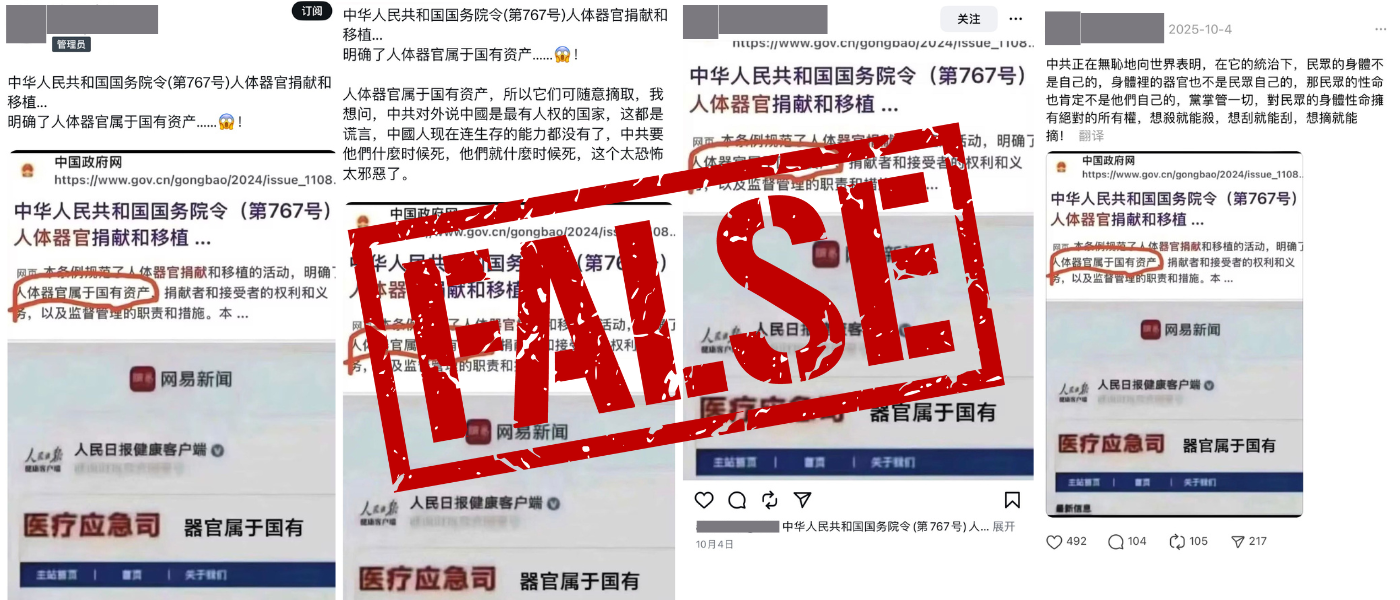
On Oct. 4, an X user posted an image compiled from two screenshots, claiming that Chinese regulations stipulate human organs are considered state property.
The top half of the image shows a search result for the “State Council Order No. 767.” The snippet alleges that the “Regulation on Donation and Transplantation of Human Organs” stipulates that “human organs are classified as state-owned assets (人体器官属于国有资产)” and outlines the rights and obligations of donors and recipients.
The lower half appears to be taken from a People’s Daily article, cross-posted on NetEase News. Next to the Department of Medical Emergency Response logo, a bolded phrase reads “器官属于国有 (Organs belong to the state).”
The compiled image has been widely shared and discussed across X (here, here and here), Instagram (here and here), Facebook, Threads (here and here), TikTok, and the Taiwan forum Mobile 01.
Annie Lab’s investigation found that the image and the accompanying claim are not new. They have been circulating since July 2024, two months after the regulation on organ donation and transplant took effect in China in May last year.
For example, Taiwan-based news outlet Newtalk included one of the screenshots in a report in July 2024, questioning China’s organ donation system. The report claimed “China’s official media clearly stated that the organs belong to the state.”
However, these claims are false. Neither the State Council order nor the People’s Daily article mentioned that organs are state-owned assets. The two screenshots were likely manipulated.
Screenshot of the State Council order
A review of the State Council of the People’s Republic of China’s Order No. 767 (archived here) shows that the phrase “human organs are state-owned assets” does not appear anywhere in the regulation.

The phrase encircled in red in the search snippet (人体器官属于国有资产) above does not appear in the text of the actual order.
In fact, Article 8 states that organ donations must be made voluntarily, while Article 9 affirms that any citizen with full civil capacity has the right to make an independent decision regarding donation.
The regulation also explicitly prohibits all forms of organ sales, coercion, deception, or inducement.
Screenshot of the People’s Daily article on NetEase
Our investigation found that the phrase “organs belong to the state (器官属于国有)” was likely digitally added to the second screenshot.

A reverse image search traced the screenshot to an older X post on July 2, 2024. It included a QR code linking to the original People’s Dairy article (archived here) on NetEase.
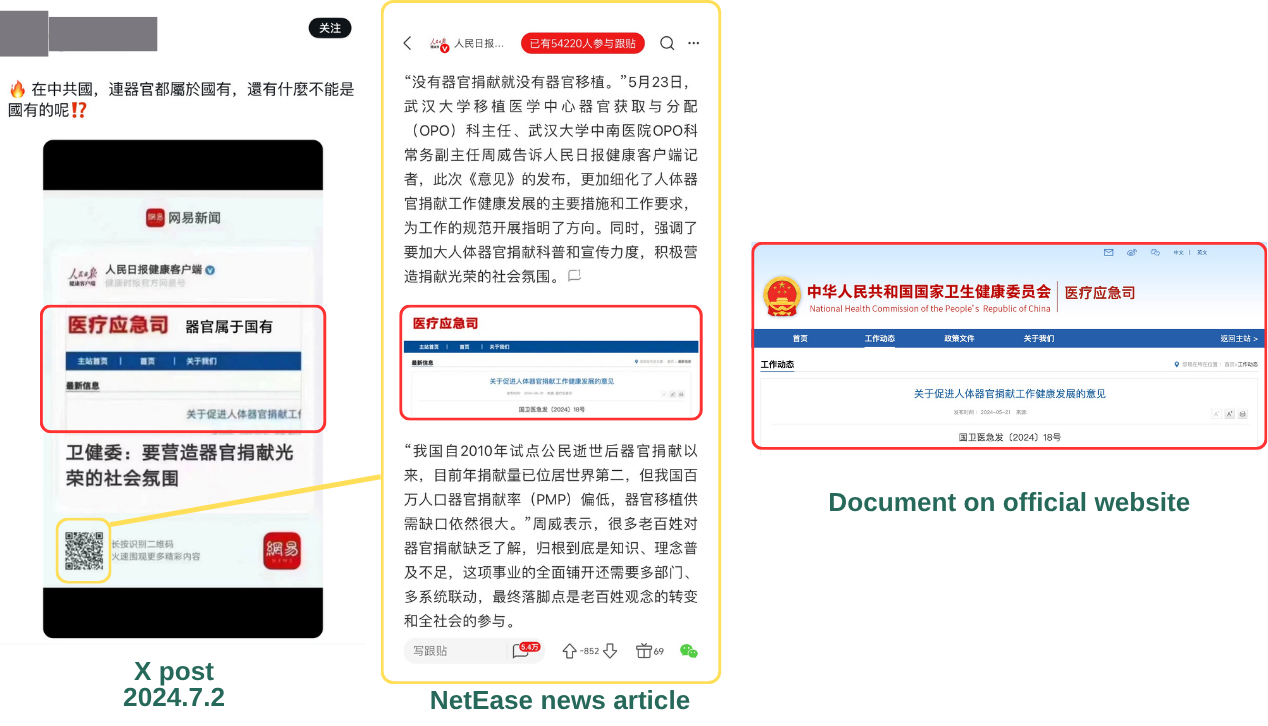
Scanning the QR code led to the original article (archived here) titled, “卫健委: 要营造器官捐献光荣的社会氛围 (Health Commission: Fostering a Social Atmosphere Where Organ Donation is Honored),” published in May 2024.
The article promotes organ donation and includes an image of a policy document (archived here) available on the website of the National Health Commission’s Department of Medical Emergency Response.
The image matches the one in the viral post, except that the phrase in question, “Organs belong to the state,” does not appear next to the department’s logo.
Neither the official document nor the article refers to organs as state property.
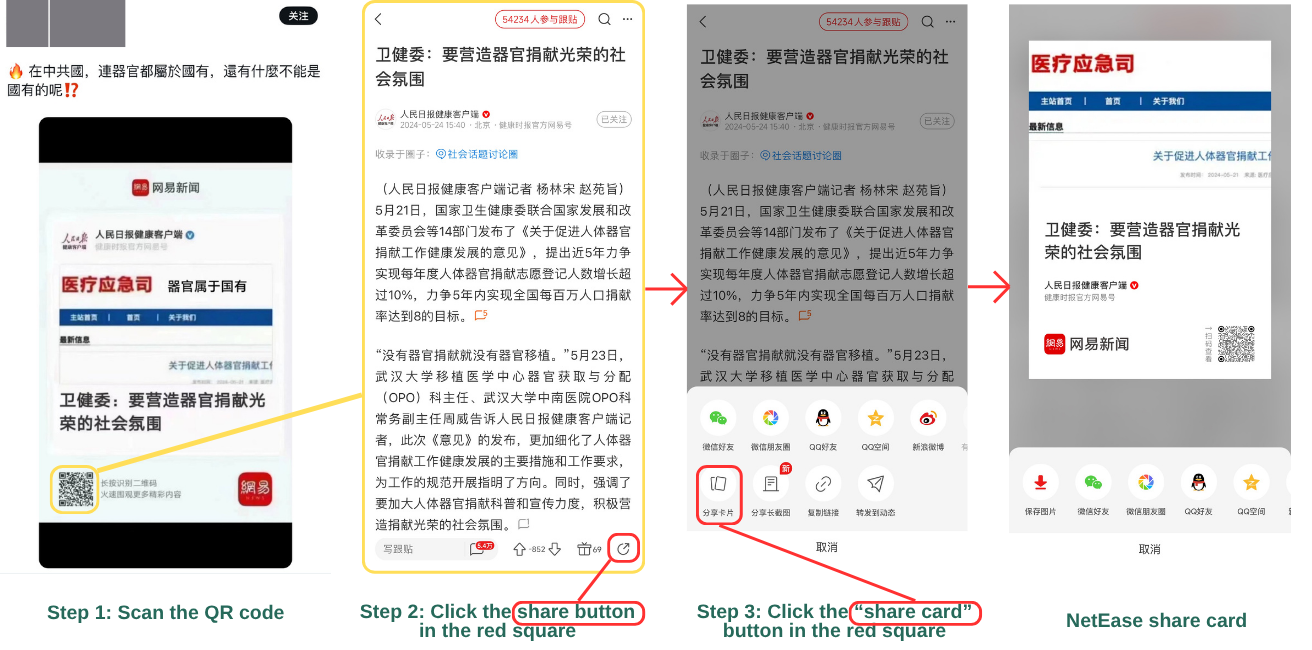
Annie Lab recreated the same NetEase News “share card” using the app’s sharing function.
Although the layout differs slightly from the old viral image, the produced image contains no text referring to state ownership of human organs.
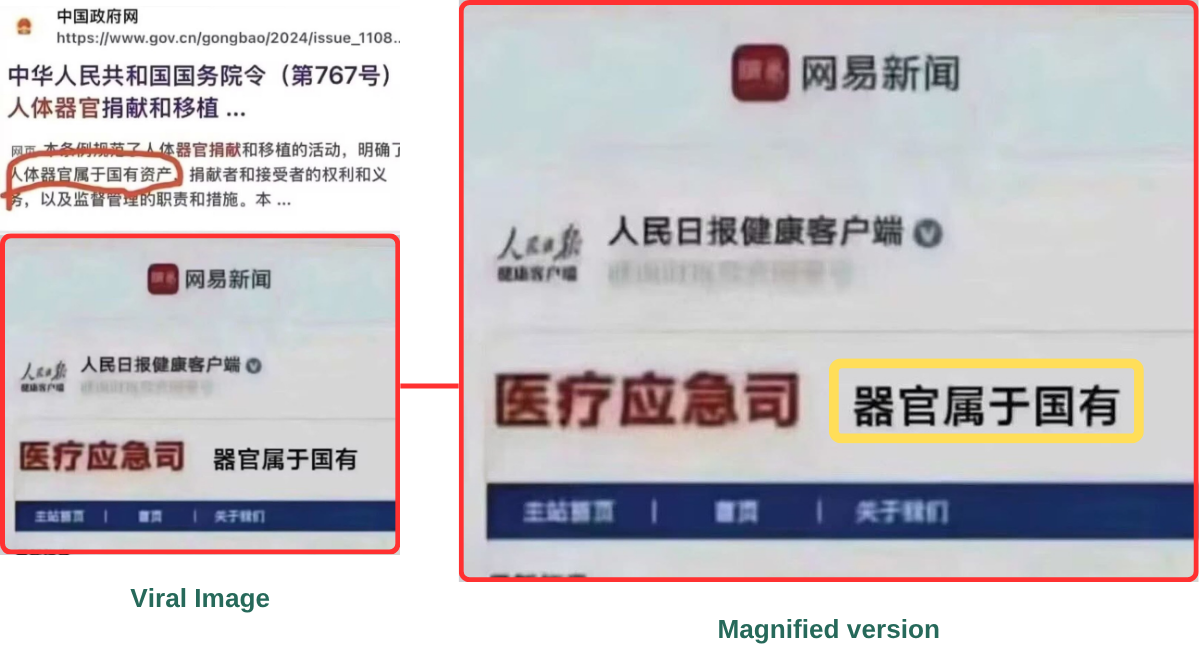
A closer analysis indicates that the pixels around the “organs belong to the state” text are noticeably sharper and more defined than the background, suggesting these Chinese characters were digitally added.
