Misleading: Video shows ByteDance’s Doubao, not HK government’s new AI chatbot

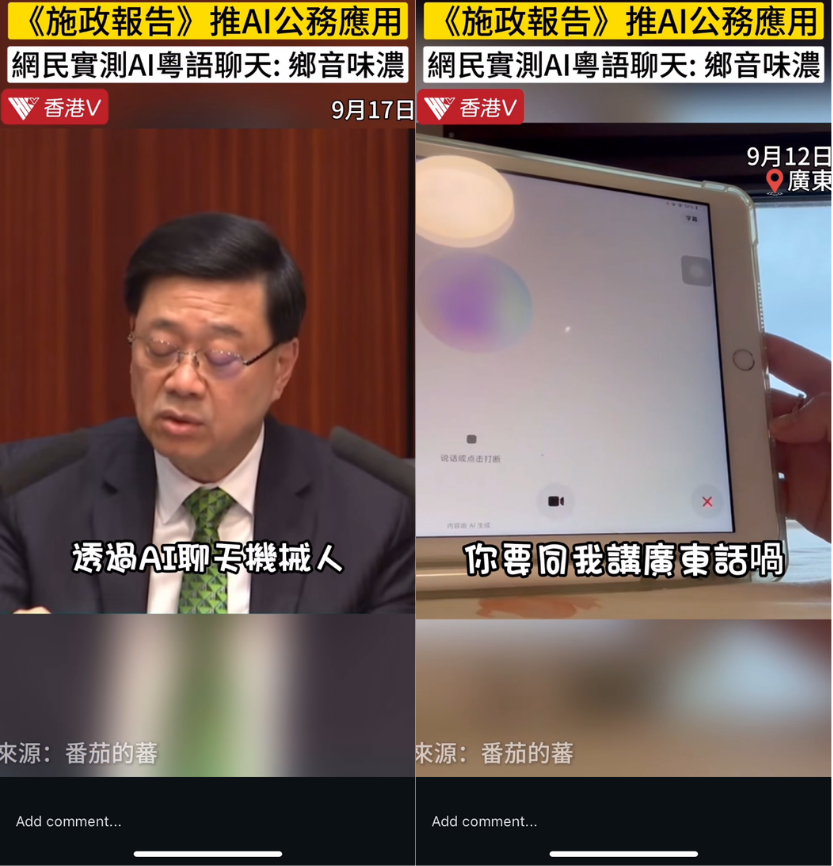
A video clip purportedly showing the Hong Kong government’s new AI chatbot has been widely shared since mid-September.
It opens with footage featuring Chief Executive John Lee’s 2025 policy address, where he discusses using AI in public services, then transitions to a user speaking Cantonese to a chatbot on a laptop.
The bot’s synthetic voice responds with heavily accented Cantonese—speaking with conspicuous tone errors—and even mixes Mandarin.
This video, shared across Instagram, Threads, and Facebook, was initially posted by Hong Kong V, a Phoenix Television affiliate serving Cantonese-speaking audiences.
Although the post does not explicitly claim that the government has made the chatbot in the clip, it is tagged with keywords such as “policy address,” “John Lee,” “AI,” and “AI Efficacy Enhancement Team” in Chinese.
Across the three platforms, their posts gained more than 134,000 likes and 196 comments. A number of viewers left cynical comments about public spending and reliance on Mainland China for an AI tool that requires Cantonese proficiency.
“Three billion dollars just fell into the sea,” one comment read. Others criticized “buying an AI technology” from the mainland (presumably, instead of developing it locally in Hong Kong).
Annie Lab looked into the footage and can confirm that the chatbot featured in the clip has nothing to do with Lee’s announcement.
This part of the video shows a demo featuring a commercial AI chatbot developed by ByteDance.
Government-backed chatbot still in development
The first clip does accurately show the Chief Executive’s speech announcing the policy address discussing the government’s future plans for AI deployment.
In recent years, the Hong Kong Government has worked to promote local development of artificial intelligence.
For example, the Hong Kong Generative AI Research and Development Centre (HKGAI) was established in 2023, supported by InnoHK of the Innovation and Technology Commission, to develop AI foundation models and associated ecosystem in the city.
In February, HKGAI released Hong Kong’s first large language foundation model, HKGAI V1, which is localized and fine-tuned based on Deepseek’s model.
HKGAI team is also developing other applications with HKGAI V1, including the document processing tool HKPilot (港文通; archived here), a localized chatbot called HKChat (港話通), and LexiHK (港法通) that offers legal support to government departments.
As of this writing, there is no mention on the HKGAI’s main or announcement page (archived here and here) of any product launch besides the LLM HKGAI V1.

Sun Dong, Secretary for Innovation, Technology and Industry, told reporters in August that the development team aimed to launch HKChat to the public in the second half of 2025.
We reached out to InnoHK and they clarified through an email that the AI chatbot featured in the video is not a version of HKChat.
An information officer also referred us to Ominiserve, the developer of HKChat. While Ominiserve declined to provide a written reply to our inquiry, a staff member answering the phone confirmed that the video does not show their product, and the HKChat is still under development.
On Ominiserve’s website (archived here), we found a link to a functional web app version of HKChat and was able to register for an account.
This version includes shortcuts labeled “Weather,” “Nearby Arrival,” “Legal,” and “Finance,” which provide direct responses when clicked.
Voice typing is enabled via a microphone icon in the text box, but there is no indication that the app currently supports voice chat.

ByteDance’s Doubao in the video
The Hong Kong V attributed the AI testing footage to “番茄的蕃”, an account on Xiaohongshu.
Annie Lab found a post by this creator (see the screenshot below) showing that the video amassed over 100,000 views althogh the video and related posts were later deleted.
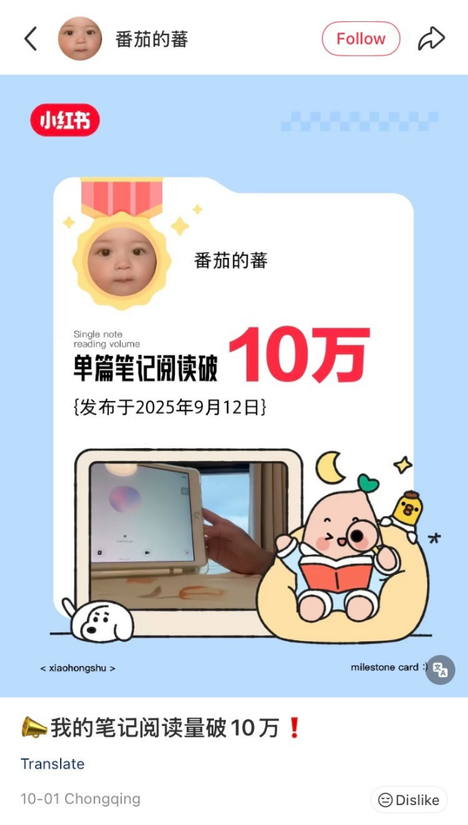
In a private message to Annie Lab, the creator confirmed that the chatbot featured in the video was Doubao (豆包), an AI chatbot developed by ByteDance.
We watched other videos featuring Doubao’s functionalities online, such as here and here, and can confirm that its interface does not look like the one presented by HKChat.
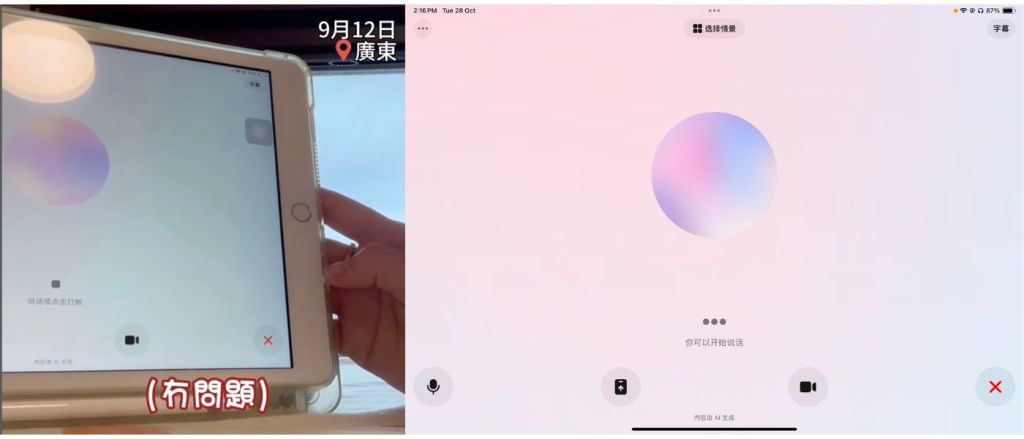
We also tested Doubao’s current ability to speak Cantonese (video below). In our testing, the chatbot performed poorly and spoke mostly in Mandarin.
[Update on Dec. 30] At the time of writing, publicly available information reflected the company’s name as Ominiserve (refer to archived link). The company has subsequently rebranded as OmniServe.