Misinformation spreads as WHO member states adopt pandemic agreement
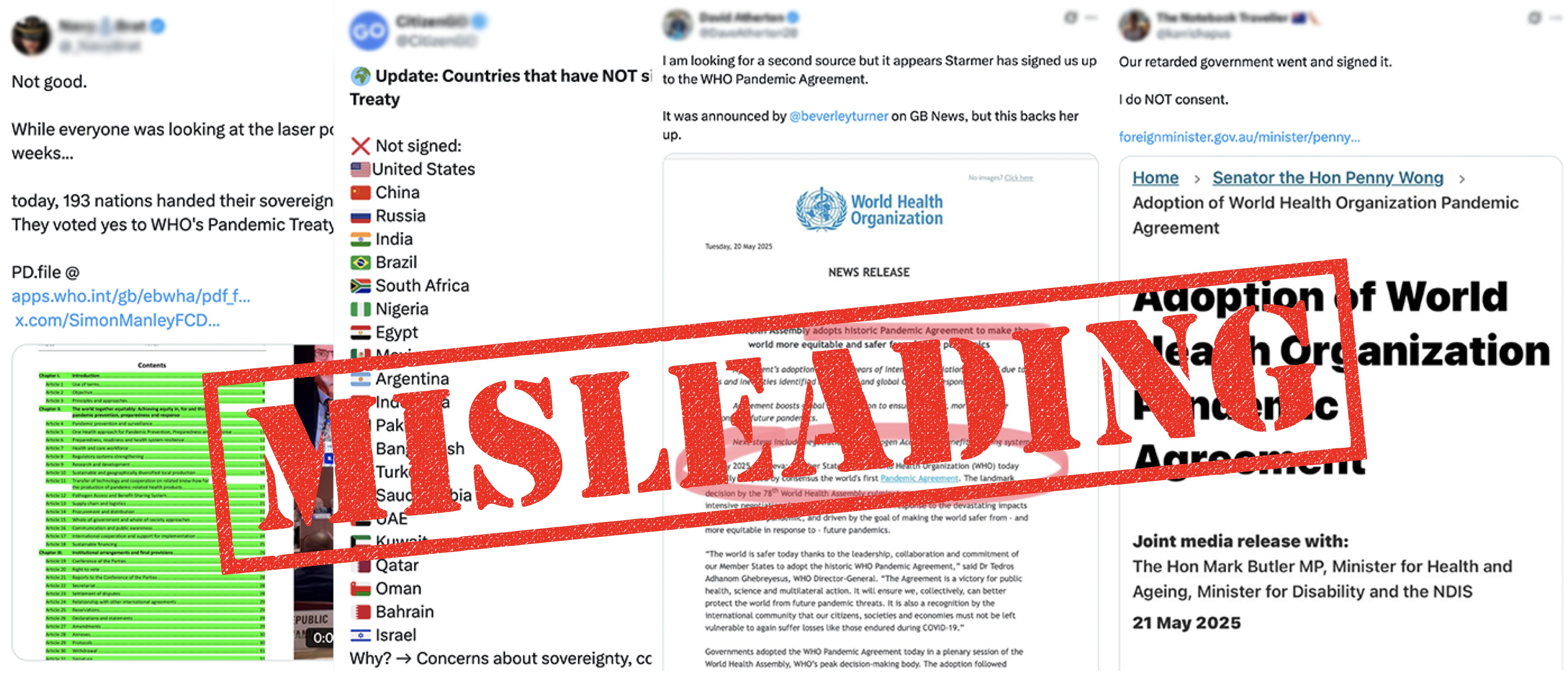
The World Health Organization’s global pandemic agreement, adopted by 124 member states on May 20, 2025, has become the subject of widespread misinformation and misunderstanding on social media.
Some posts on platforms like X claim that the agreement was “signed” by many countries and is now legally binding (for example, here and here).
Other users suggest the accord will strip nations of their sovereignty (for example, here) during future pandemics, with some protesters reportedly gathering outside the United Nations’ headquarters in Geneva.
Several social media posts and comments have named specific countries that “signed” or “did not sign” the agreement. Collectively, these claims attracted hundreds of comments and thousands of reposts.
Annie Lab also found discussions about this news on X, Facebook and Weibo, with some users expressing concern about how the accord might affect their country’s public health and social policies, with similar sentiments that a member nation might be forced to take certain actions.
However, a review of official documents shows these claims are misleading and sometimes name the wrong countries.
Adopted, not signed
The agreement was “adopted” at the 78th World Health Assembly in Geneva by 124 member countries that voted in favor, with 11 abstentions and no objections. The news made headlines across the world, including China.
Adoption is a formal act that establishes the form and content of the treaty text but does not make it legally binding on individual countries.
Signing a treaty, in contrast, indicates a state’s intent to be bound by its terms, although a signature does not by itself create a binding legal obligation, either, according to the United Nations’ official Treaty Handbook.
In most cases, signing is followed by ratification or its equivalent in each country before it becomes legally binding. Contrary to social media claims, the pandemic agreement did not become legally binding upon adoption.
Some international news media also used the word “sign” in the headlines, even though the agreement document specifically says that the treaty will be “open for signature” at a later stage.
In fact, several conditions must be met before the agreement takes any binding legal effect:
- An annex on Pathogen Access and Benefit Sharing (PABS) must be drafted and negotiated, a process expected to take up to a year. PABS is a mechanism that centralizes “data and gene sequencing for pathogens with pandemic potential,” according to Geneva Solutions.
- After the PABS annex is adopted, the agreement will be open for signature and ratification by individual countries.
- At least 60 countries must ratify the agreement before it enters into force, and each country determines its own ratification process.
Sovereignty explicitly mentioned and preserved
The adopted text and related documents explicitly refute the misleading narrative that the agreement will cause member nations to lose sovereignty.
The accord states that nothing within it gives WHO any authority to change or interfere with national laws, or to force countries to implement pandemic measures such as travel bans, mandatory vaccinations, or lockdowns.
The People’s Health Movement, a network of grassroots health activists, reported that among the abstaining countries, Russia and Italy cited concerns over state sovereignty as one of the reasons for not voting.
Eleven nations abstained; U.S. was absent
The 11 abstaining countries reportedly include Bulgaria, Iran, Israel, Italy, Jamaica, the Netherlands, Paraguay, Poland, Russia and Slovakia.
It is not true that all European nations adopted the agreement, or that China did not adopt it, as opposed to what some online commentaries suggested. In fact, China’s state-controlled media outlets widely reported the news, often emphasizing the country’s contribution to the “historic” agreement.
The United States was absent from the assembly, as the country is in the process of withdrawing from the WHO.
[This story was updated on May 26, 2025, to add links to more documents explaining the differences between “adopting” and “signing” a multilateral treaty.]