False: No recent data shows ‘half of Chinese men die before 68’
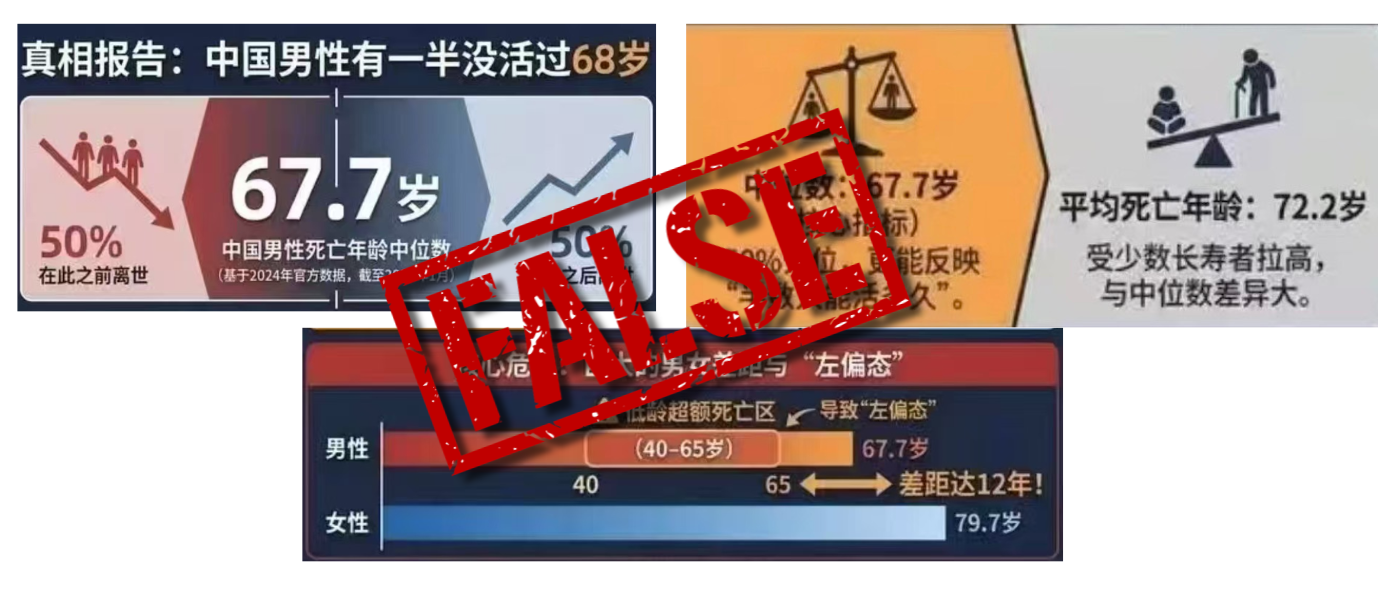 A viral post by a Chinese financial influencer on X claimed that “half of Chinese men don’t live past the age of 68,” a figure that does not exist in any official records.
The post, which spread widely in early February, lists four strategies for managing health and financial assets. It included an infographic with figures on median life expectancy and the gender gap without citing any credible sources.
Similar claims have appeared across multiple platforms, including Weibo, Zhihu and Tencent. Posts on Weibo and Tencent allege that, according to “official 2024 data” from China’s National Bureau of Statistics, the median age of death for men is 67.7 years, significantly lower than 79.7 years for women.
However, these claims rely on figures that do not appear in any official records.
Verifying the data
In China, annual data for a given year is typically published in the following year’s Statistical Yearbook produced by the National Bureau of Statistics, which documents the country’s social and economic statistics in details.
The 2024 Yearbook, however, does not contain any age-specific mortality data.
Detailed age-at-death statistics are primarily collected during the National Population Census, conducted once every 10 years.
The most recent comprehensive data on mortality breakdowns by age and gender comes from the 2020 National Population Census released in May 2021.

Source: China Population Census Yearbook 2020
Using data from the 2020 Census Yearbook, which tracked deaths between November 2019 and October 2020, Annie Lab calculated that the median ages at death for men and women in China were approximately 73 and 79 years, respectively. That is a gap of six years, not the 12-year difference claimed in the posts.
Chinese media outlets also tried to trace the claim back through the social media sharing chain and found that different posts attributed the figure to entirely different sources.
Some said the National Bureau of Statistics, some the United Nations, some the Chinese Academy of Social Sciences, some census data. A professor at Fudan University, quoted in Chinese media, said the figure does not appear in authoritative data and warned the public not to be misled.
Unsubstantiated figures
The infographic also provides specific median ages at death for urban and rural residents, as well as for various income and occupational groups.
While the Census Yearbook tracks deaths by educational level and urban or rural location, it does not cross-reference those with age at death.
Annie Lab could not trace any official government data that tracks age at death by income bracket or occupational category. These figures may have been fabricated, or as suggested by some Chinese media, caused by AI hallucination.
Misrepresented demographic concepts
The posts on X and Weibo appear to misrepresent several demographic measures. For example, they show “average age at death” in China, but that is not a meaningful statistic.
The average is calculated by adding up all ages at death and dividing by the number of deaths, which makes it highly sensitive to extremes such as infant deaths or very young fatalities. A single death at age zero can pull the average down sharply, even if most people die much later in life.
The median, by contrast, is the age at which half of all recorded deaths occur before that age and half after, making it a more robust indicator of how long most people actually live.
Demographers also rely on life expectancy at birth, which is a model-based estimate of the average number of years a newborn is expected to live under current mortality conditions, rather than a simple arithmetic average of observed deaths.
A recent official statement from China’s National Health Commission (archived here) put the average life expectancy for 2025 at 79.25 years. The 2024 Statistical Yearbook lists 75.37 as the average life expectancy at birth for men and 80.88 for women.
The term “excess mortality (超额死亡)” appears in the social media posts to describe deaths occurring between the ages of 40 and 65 as well, attributing these to “cardiovascular diseases, cancer and accidents.”
But this is a misuse of the term. In fact, “excess mortality” refers to deaths from all causes above an expected baseline during a defined period, such as a pandemic or an extreme weather event. Describing routine deaths from diseases or accidents as “excessive” without any baseline for comparison is a misrepresentation of the concept.

