Misleading: Image of a girl with scaly skin has nothing to do with Israel-Hamas war
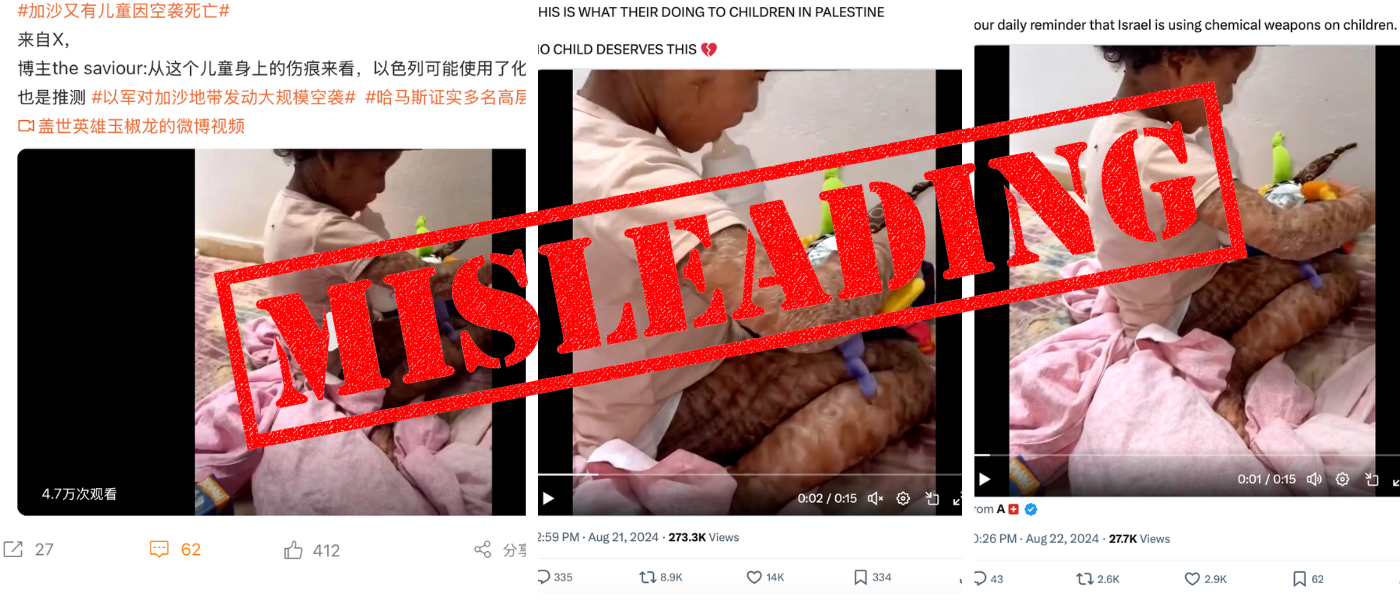
A video of a child with thick, scaly skin on her limbs circulated on Weibo on March 18. The Simplified Chinese caption quoted speculation from an X user that Israeli chemical weapons might have caused the child’s condition.
Annie Lab could not trace the video to the named X user, but we learned that similar claims have been circulating with this video on X since last August, all suggesting the girl was a Palestinian victim of Israeli chemical weapons.
The earliest post we found was from August 20, 2024. While this one didn’t mention chemical weapons, users supporting Palestine associated the video with the ongoing Israel-Palestine conflict. More explicit claims appeared days later (here and here), and then the footage resurfaced in January 2025 (here and here).
These posts garnered over 80,000 likes, 41,000 shares and 900 comments. Most comments condemned Israel’s alleged use of chemical weapons and the harm inflicted on children.
Human rights groups, such as Human Rights Watch and Amnesty International, have reported on Israel’s illegal use of white phosphorus weapons against civilians in Gaza and Lebanon in the past two years. Israel denied these claims, according to the Guardian and the Times.
However, our investigation indicates that the girl in the video and her family live in Morocco. With translation help from Dr. Moath Althaher and Loay Khreis from the Jordanian fact-checking organization Fatabyyano, we learned that she has ichthyosis, a primarily congenital skin disease.
Identifying the origin
The video in question had an Instagram watermark with a user handle, which led us to the Instagram account (archived here) belonging to a mother with a young daughter matching the girl’s appearance.
We then found her other accounts on YouTube, Facebook and TikTok, as well as her husband’s Facebook (archived here, here, here and here).
The woman describes herself as a married mother of two. She shares her experience caring for her daughter with ichthyosis and offers medication advice.
In her videos, reels (here and here) and Facebook biography (archived here), the mother identifies her daughter’s condition to be “مرض السمكية” in Arabic, or ichthyosis in English. The Arabic word translates to “fish disease” literally, referring to the appearance of the skin.
The child’s father confirmed to Annie Lab via private messages on Facebook that the viral video shows his daughter, who was diagnosed with ichthyosis.

The skin disorder
Ichthyosis, which comes from the Greek word “ichthys” meaning fish, typically features scaly, dry and rough skin resembling fish scales, according to the British Association of Dermatologists (BAD). This aligns with the symptoms described by the mother in a YouTube video (archived here).
The National Institute of Arthritis and Musculoskeletal and Skin Diseases in the United States says ichthyosis is mostly caused by genetic mutation, with some cases developing due to other medical conditions or medications. Patients are affected by abnormal skin growth and shedding cycles.
The mother said in one YouTube video (archived here) that doctors have not agreed on a specific cause of her daughter’s ichthyosis. In the same video, the father mentioned being happy and nervous when he first saw their daughter, who had somewhat scaly skin, after birth.
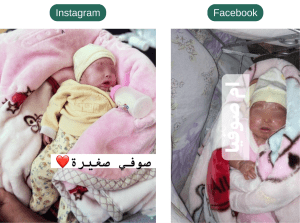
Photos shared on Instagram (archived here) and Facebook (archived here) show the girl had dry, scaly skin symptoms as an infant, indicating the condition has existed since birth.
Family’s residency
The mother’s Facebook profile (archived here) lists Tata, Morocco, as her hometown and Agadir, Morocco, as her current residence. In this YouTube video (archived here), she says the family lives in Agadir as well. She also talked about visiting Turkey in the video, but there was no mention of conflict areas such as Gaza or Lebanon.
Contact with the girl’s family
While the child’s mother didn’t respond to Annie Lab’s messages, she posted on Facebook (archived here) that “Someone took our photos and posted them on a page claiming we’re from Gaza and that we have died. Tomorrow, we will report the page” shortly after we reached out.

